
Recently, I was speaking with one of my mentors, Travis Davison, vice president of SBG International, when he said something that stayed with me:
“Your heart is where your treasure is.”
I kept thinking about what it asks us to consider. What do we treat as valuable enough to give ourselves to? What receives our attention when there is no audience and no immediate reward?
Money can be part of that answer. So can the time we protect, the effort we give, and the care we offer another person.
There is a deeper possibility here, too: what we invest in can help shape what we come to love. We can begin giving something our attention before we fully understand how much it will matter to us.
Attention makes our priorities visible
In Jiu-Jitsu, you have choices about where to spend your attention. You can work on the escape that keeps failing. You can listen carefully to a correction. You can notice that your partner needs a different level of resistance to learn.
Those choices give your values a practical expression. Valuing improvement means making room for the parts of training that expose a weakness. Valuing your teammates means considering their experience while you pursue your own goals.
In an interview about learning Jiu-Jitsu, SBG coach Stephen Whittier describes the importance of becoming more invested in long-term growth than in a single victory. That gives us a useful way to consider what we treasure: are we taking care of the body and the training partners that make years of learning possible?
Of course, circumstances matter. A parent who misses training to care for a child may be living this principle beautifully. Work, health, and family responsibilities shape the choices available to us. The useful question is personal: within the life I actually have, am I giving attention to what I say matters?
Aliveness keeps our training honest
SBG’s training philosophy begins with a concern for truth. Epistemology is the question of how we know something. In martial arts, Aliveness gives us a way to investigate: timing, energy, and motion, with resistance appropriate to the people and the problem.
If I believe I can escape a position, a partner who responds and resists gives me information about that belief. I can examine where I lost connection, what I misunderstood, and what needs more work.
Matt Thornton makes this concrete in Three Rules for Rolling. A coach whose guard has just been passed can suddenly start instructing to disguise the loss of control. Rolling honestly means accepting what happened. In that moment, the coach has a choice about how much truth matters when it costs a little status.
The lesson I take beyond the mat is to examine my account of myself with some of that same curiosity. If I say learning matters, how do I respond when someone shows me a gap in my understanding? If I say community matters, do I notice the person who has nobody to partner with?
These questions connect with our discussion of personal responsibility. We can change a habit or give the next round a clearer purpose.
Care can grow through practice
A new student might begin Brazilian Jiu-Jitsu because they want exercise, self-defense skills, or simply something interesting to do after work. A deep attachment to the art is hardly a requirement for walking through the door.
That attachment can develop through participation. You spend time on a difficult problem. Someone helps you understand it. You begin recognizing the people you train with. Eventually, you notice yourself caring about a teammate’s progress as well as your own.
You have contributed something of yourself, and the experience has become more meaningful.
Caring also makes disappointment possible. In his writing about competition and failure, Travis makes room for students to be upset about losing while helping them keep that loss from becoming a judgment on their worth. We can care deeply about our effort and still have room to learn from its outcome.
This is one way I understand the connection between treasure and heart. We often wait to feel motivated before committing our attention. Sometimes the willingness to participate comes first, and affection grows through the effort.
SBG’s I-Method supports that participation through Introduction, Isolation, and Integration. Understanding develops through focused live practice and then the larger game. There is a workable next step, even when inspiration has apparently taken the evening off.
A tribe is something we help build
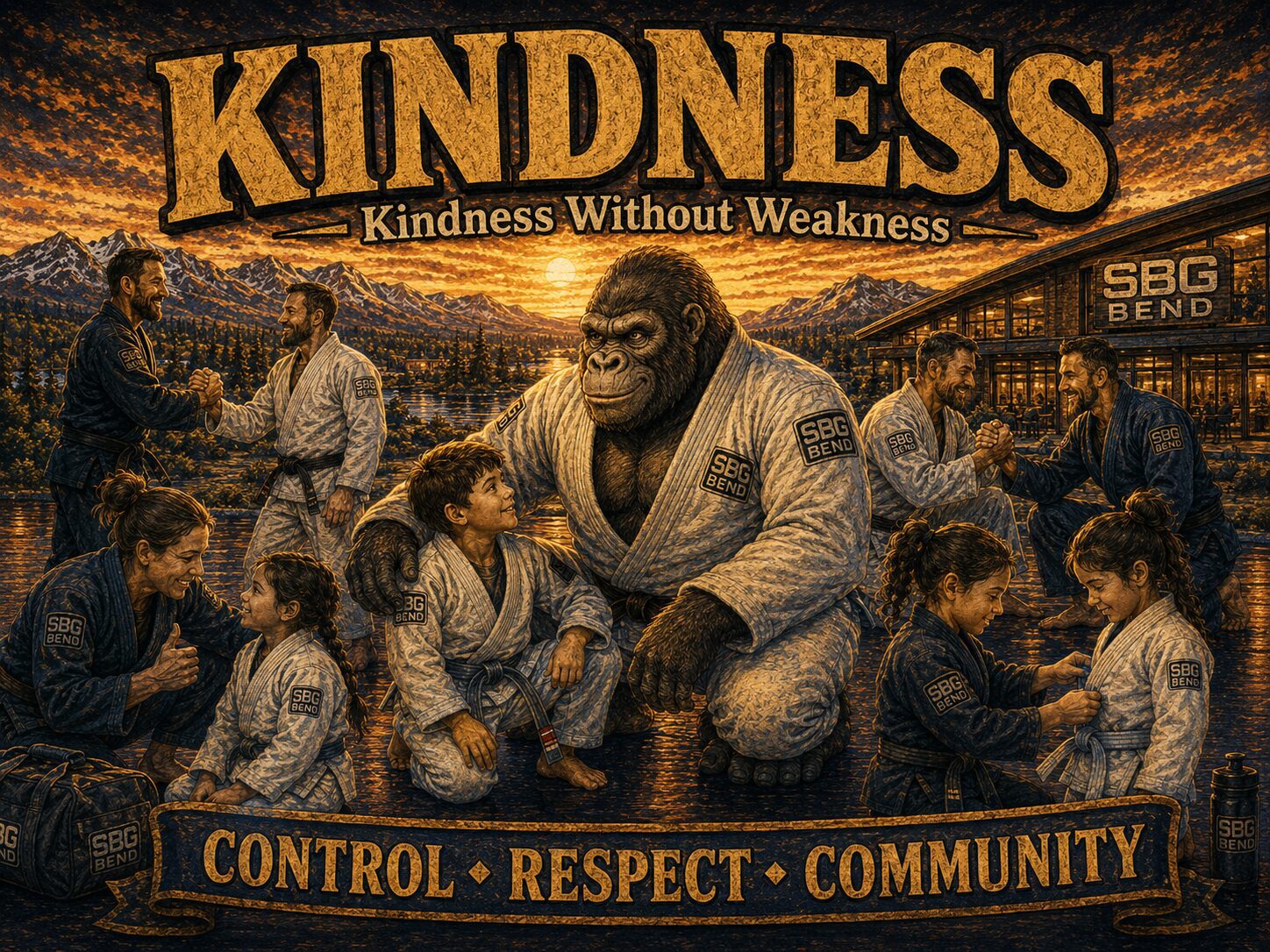
At SBG Bend, people arrive with different goals. Some want to compete. Some want to become more capable in self-defense. Parents bring children who are learning how to face a challenge and work with others.
In his writing about belonging, Travis describes a community where training includes improving yourself and the person beside you. That puts a responsibility on everyone in the room.
That contribution can be small and specific. Learn a new student’s name. Give your partner your attention during a drill. Take their boundary seriously. Stay curious when a coach offers a correction.
Our article on kindness in martial arts explores the care and control that make a useful training partner. Those qualities take effort. They are part of what we give to the room.
Coaches demonstrate what we treasure through what receives our attention: the student struggling to understand, the question that deserves a thoughtful answer, the behavior that needs addressing. Leah Taylor’s writing about women’s classes reminds coaches to consider people’s reasons for training and respect their choices about participation. Caring about a student includes taking their goals seriously.
A community deserves the same care we ask its members to give. That is how I think about One Tribe One Vibe. Each person has a part in making the experience worth belonging to.
Choosing where to put your heart
One of the useful questions in BJJ philosophy is what our training is helping us practice beyond technique.
A difficult round gives us an opportunity to listen, adjust, and keep learning. Carrying that approach into the rest of life takes intention. At home, it might mean giving a conversation our full attention. At work, it might mean admitting that a familiar approach needs to change.
We can also ask whether what we are investing in still deserves that investment. SBG’s commitment to truth asks us to remain open to revising our understanding. Experience may give us good reasons to change how we train, where we put our effort, or what we support.
This week, choose one thing you value and give it something concrete. Work patiently on the skill you have been avoiding. Help someone find their place in the room. Make time for the person who keeps receiving your distracted attention.
Then notice what happens to your relationship with it.
Your heart may already be there. It may also be learning the way.
This is SBG. You’ll be OK.
Considering Brazilian Jiu-Jitsu in Bend, Oregon? Come meet us, ask questions, and see how we train.