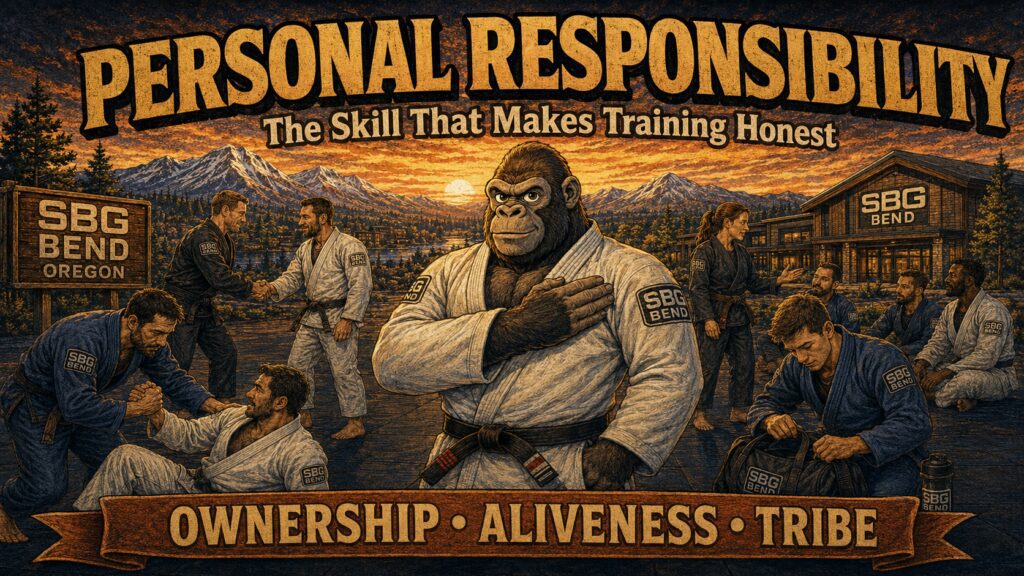
This month's Lifeskill is Personal Responsibility.
That sounds simple enough. Be responsible. Own your actions. Pack your gear. Show up on time. Don't be a menace in the group chat. Cool.
But at SBG Bend, personal responsibility goes deeper than basic adulting. It is one of the hidden skills underneath every good round, every good training partner, every good coach, and every real improvement you ever make on the mat.
Personal responsibility is not self-blame.
It is ownership.
Self-blame says, "I'm terrible."
Ownership says, "What happened, what part was mine, and what can I do next?"
That difference matters. One shuts learning down. The other opens the door.
Personal responsibility starts with truth
SBG has always been built around a simple but uncomfortable idea: our preferences do not determine what is true. If we want to know what works, we have to test it honestly. That is the heart of SBG's philosophy of Truth, Aliveness, and Adaptability: SBG Philosophy: Truth, Aliveness, Adaptability . In normal-person English: we do not guess. We train, test, observe, adjust, and repeat. Matt Thornton's concept of Aliveness gives us the method. Training has to include timing, energy, and motion. It has to involve realistic movement and appropriate resistance, because that is where truth shows up: Matt Thornton: Why Aliveness . And this is where personal responsibility gets interesting. Alive training tells the truth, but it does not interpret the truth for you. That part is yours.The mat does not care about your excuses
If your guard gets passed, you can say:- "He's too strong."
- "She's too fast."
- "I'm just bad at this."
- "That move does not work."
- Did I lose inside position?
- Did I stop moving?
- Did I frame too late?
- Did I rely on strength instead of structure?
- Did I understand the goal of the drill?
Personal responsibility is learning how to learn
At SBG Bend, we are not trying to create students who need to be spoon-fed forever. A good coach helps you become more capable of coaching yourself over time. Matt Thornton's coaching model emphasizes fundamentals, the natural order in which those fundamentals arise, and helping students understand why they work: Matt Thornton: Coaching the SBGi Way . That matters because the fastest learners are not always the strongest, youngest, or most athletic. They are often the people who think about their own game. They ask why things work. They notice patterns. They get curious instead of defensive. That is personal responsibility:- paying attention to your own habits,
- asking better questions,
- taking correction without turning it into a personal crisis,
- and becoming an active participant in your own development.
The I-Method is responsibility with structure
SBG's I-Method gives that learning a repeatable path: Introduction – Isolation – Integration We break this down often because the process matters. It is one of the ways SBG keeps training honest, useful, and sustainable: Matt Thornton: Notes on Drilling .1) Introduction: pay attention
This is where you learn the movement or concept clearly, without resistance. Personal responsibility here looks like attention:- Listen.
- Ask questions.
- Learn the movement before adding speed.
- Do not turn every new detail into your own garage-band remix.
2) Isolation: train honestly
This is where SBG shines. Isolation is alive drilling inside a defined problem with progressive resistance. Not fake resistance. Not maximum chaos. The right amount of resistance for learning. A simple calibration rule:- If you succeed every time, it is too easy.
- If you fail every time, it is too hard.
3) Integration: accept the data
Integration is where you put the piece back into the whole. If it works, great. If it fails, great. Either way, you got data. Personal responsibility here looks like humility. You do not collect moves. You build a game that survives contact.You are someone else's training environment
Personal responsibility is not only about your own progress. It is also about the room. Every time you train, you are part of someone else's learning environment. That means your behavior matters. A responsible training partner can:- increase resistance without becoming reckless,
- lower resistance without becoming fake,
- follow the rules of the drill,
- tap early,
- catch and release,
- ask, "Was that too much?" without making it weird,
- and help the person across from them get better.
Responsibility is not doing everything alone
There is a bad version of personal responsibility that says: "Everything is on me. I should never need help. I should figure it out alone." That is nonsense in a rashguard. SBG is a tribe for a reason. Coaches matter. Partners matter. Culture matters. Mentorship matters. One Tribe, One Vibe is not just a nice slogan for the wall. It is a practical training reality. People improve faster in rooms where they feel safe enough to fail, supported enough to continue, and challenged enough to grow: What Is SBG? . Personal responsibility does not mean refusing help. It means taking an active role in your own development:- Ask the question.
- Take the correction.
- Drill the thing you avoid.
- Tell your partner what you are working on.
- Show up when motivation is off duty.
- Rest when you are injured instead of trying to win the Tough Guy Olympics and donating your knee to science.
Why this matters for self-defense
Personal responsibility also matters in self-defense. Real self-defense is not fantasy. It is not pretending the world is safe, and it is not living paranoid either. It is taking responsibility for your boundaries, awareness, communication, fitness, skill, and decision-making. Can you stay calm under pressure? Can you use your voice? Can you leave early instead of escalating? Can you control someone without needing to injure them? Can you protect yourself if leaving is no longer an option? These are not abstract questions. They are adult questions. Parent questions. Human questions. Alive training gives us a place to practice pressure honestly and safely. The goal is not to turn everyone into a fighter. The goal is to help good people become more capable, more calm, and harder to bully.Why this Lifeskill matters for kids and parents
This article is not just about kids, but kids make the lesson easy to see. For children, personal responsibility has to be trained in age-appropriate ways. You cannot lecture a six-year-old into becoming responsible. You give them reps:- Find your spot on the mat.
- Tie your belt.
- Listen when the coach is talking.
- Be a good partner.
- Use your words.
- Try again.
- Pack your water.
- Help the newer student.
- Notice what went wrong.
- Say what you will do better next time.
- packing their own gear,
- remembering their water,
- handling frustration better,
- speaking more clearly,
- helping younger students,
- recovering from losses faster,
- and asking, "What can I fix?" instead of melting into a puddle.
The SBG version: ownership without ego
Personal responsibility can go wrong when it becomes ego in disguise. There is a big difference between:- "I own my progress."
- "I must prove I am good every round."
The bottom line
Personal responsibility is the skill that keeps training honest. It is what lets adults face feedback without excuses. It is what lets competitors fix holes instead of protecting their favorite story about themselves. It is what lets hobbyists train safely for years. It is what lets parents help kids build ownership without turning every mistake into a courtroom drama. And it is what lets a tribe function. At SBG Bend, we train alive because truth matters. But truth only helps if we are willing to own our relationship to it. So this month, keep it simple:- Show up.
- Pay attention.
- Be honest.
- Be useful to your partner.
- Ask better questions.
- Own your part.
- Adjust.
- Repeat.