Homeschool families already understand something important: education is bigger than a desk.
But some lessons need other people.
Learning to speak clearly in front of a group, work with a partner, handle pressure, accept correction, recover from mistakes, lead without bossing, and help someone who is struggling cannot be mastered through a worksheet.
Kids need a place to practice those things for real.
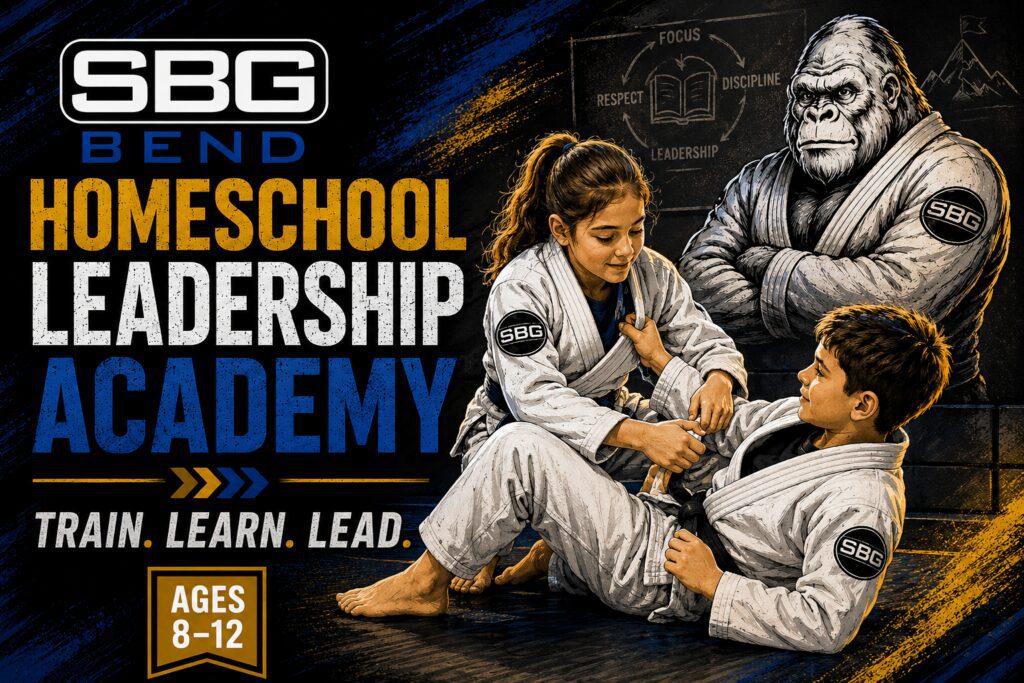
That is why we are launching the SBG Bend Homeschool Leadership Academy, a twice-weekly program for homeschool students ages 8-12 that combines age-appropriate Brazilian Jiu-Jitsu, movement, life skills, coaching, teaching, healthy habits, and real leadership practice.
This is not daycare in gis.
It is not a lecture series where adults tell children to “be leaders” and hope something sticks.
It is a structured environment where kids train, learn, contribute, reflect, and gradually take on more responsibility.
Homeschool Leadership Academy: Dates and Schedule
- Ages: 8-12
- Open House: Tuesday, August 25, 2026 at 1:30 PM
- Classes Begin: Thursday, September 10, 2026
- Schedule: Tuesdays and Thursdays, 1:30-3:00 PM
- Location: SBG Bend, 550 NW Franklin Ave, Suite 338, Bend, Oregon
- Contact: hello@sbgbend.com or 541-697-4440
Why Use Brazilian Jiu-Jitsu to Teach Leadership?
Because Jiu-Jitsu makes learning honest. A child can memorize the definition of perseverance. It is harder to fake perseverance when a technique does not work on the first try, a partner changes direction, or a problem requires a new solution. A child can repeat the word teamwork. It becomes real when another student is trusting them to drill safely, give useful feedback, and control their body. A child can be told to stay calm. Jiu-Jitsu gives them a safe, coached place to practice staying calm while another human being is moving, resisting, and making the problem unpredictable. That is the heart of SBG’s approach. SBG was built around a simple question: How do we know something works? Our answer is not rank, tradition, or choreography. We test it. In SBG language, that truth-seeking process is called Aliveness: training with timing, energy, and motion. For children, Aliveness does not mean chaos, maximum intensity, or tiny cage fighters trying to win practice. It means movement and resistance are real enough to create learning, then carefully scaled to the child’s age, experience, and task. The result is immediate feedback. Try. Observe. Adjust. Try again. That loop develops more than functional martial arts. It develops adaptability, curiosity, humility, patience, and personal responsibility.The SBG Way of Learning: Introduction, Isolation, Integration
SBG coaches use a teaching process called the I-Method:1) Introduction: learn the skill clearly
The coach introduces a movement, concept, or skill clearly and without resistance. Students learn what to do, how to do it safely, and why it matters.2) Isolation: solve a focused problem
The skill goes into a focused game or drill with progressive resistance. The problem is small enough to understand but alive enough to require timing, decisions, and adjustment.3) Integration: put it back into the whole
Students put the skill back into the larger game, where they learn to recognize and use it naturally. This is not a one-way trip from “beginner” to “advanced.” It is a learning loop. Introduce the problem. Isolate it. Test it in context. Notice what breaks. Begin again with better information. We also use questions, games, and guided discovery because children learn best when they are active participants. SBG founder Matt Thornton describes play as the optimal learning state. Play keeps children engaged, but it is not aimless. A well-designed game preserves the problem the coach wants students to solve while giving them room to discover how their own body and mind solve it. In other words, the kids will have fun. Sneakily, they will also be learning.What Students Will Do in Class
Each 90-minute Homeschool Leadership Academy class combines physical training with leadership and character development. Depending on the lesson, students will:- Build agility, balance, coordination, and core strength
- Learn age-appropriate Jiu-Jitsu fundamentals through games and purposeful drills
- Practice safe falling, takedowns, guard work, positional control, escapes, and submissions when appropriate
- Work through coached partner problems with progressive resistance
- Discuss the monthly Growing Gorillas life skill
- Practice positive coaching and clear communication
- Demonstrate or teach a movement to classmates
- Set goals and reflect on what worked, what did not, and what to improve
- Learn habits related to hydration, nutrition, sleep, recovery, organization, and positive self-talk
- Take on age-appropriate responsibilities that help the class and community
Four Paths. One Goal: Becoming the Best You.
The Homeschool Leadership Academy is organized around four leadership chevrons. Each one turns an abstract quality into something a child can practice and demonstrate.Blue Coaching Chevron: Encourage, Support, Inspire
Coaching teaches children how to help another person improve without becoming negative, frantic, or controlling. Students practice speaking clearly, giving one useful cue at a time, using positive “do” language, and helping a teammate stay composed. They learn that good coaching is not yelling louder. It is paying attention, communicating well, and serving the person doing the work. That practice carries directly into group projects, team sports, friendships, and family life.Purple Teaching Chevron: Communicate, Demonstrate, Empower
Knowing something and teaching it are different skills. Students learn how to explain why a lesson matters, break a movement into clear steps, identify common mistakes, demonstrate from useful angles, ask questions, and involve the group. Standing in front of classmates and teaching a skill gives children repeated, supported practice with public speaking and leadership. The goal is not to create a room full of tiny lecturers. It is to help children organize their thoughts, communicate with confidence, and make other people more capable.Brown Healthy Lifestyle Chevron: Nutrition, Habits, Balance
Leadership starts with learning to manage yourself. The Healthy Lifestyle path introduces age-appropriate lessons about food, hydration, sleep, recovery, screen time, organization, goal-setting, and self-talk. Students connect everyday choices with how they feel and perform – not just on the mats, but at home and during schoolwork. We are not asking eight-year-olds to become nutrition researchers. We are helping them notice cause and effect, make better choices, and take increasing ownership of their health.Gold Leadership Chevron: Responsibility, Initiative, Service
Leadership is not a title. It is useful action. The Gold Leadership path gives students real opportunities to help others, lead by example, and serve the community. In the broader Growing Gorillas Leadership curriculum, students work toward documented service, including at least 12 hours over three consecutive months, while applying the coaching and teaching skills developed in the earlier chevrons. They learn that leadership is not being the most important person in the room. It is noticing what the room needs and being willing to help.Life Skills Need Repetitions Too
Every month, SBG Bend introduces a new Growing Gorillas life skill. The curriculum includes qualities such as independence, initiative, patience, sportsmanship, gratitude, integrity, personal responsibility, teamwork, discipline, honesty, humility, courage, focus, commitment, confidence, kindness, compassion, perseverance, self-respect, adaptability, and leadership. But a word on a poster does not change behavior. So we give each life skill a practical loop:- Mat chats: Coaches lead short, age-appropriate conversations about what the skill means and how it applies on and off the mats.
- Help at home: Students look for useful ways to contribute to their family.
- Good deeds: Children practice noticing opportunities to be kind, respectful, helpful, or brave.
- Recommended reading: Families can continue the conversation through books connected to the monthly theme.
- At-home exercises: Students use age-appropriate activities for action, reflection, and practice.
Why This Matters for Homeschool Families
This program is not built on the tired idea that homeschool children need to be “fixed” socially. Homeschool families in Central Oregon are already creating rich, individualized educational lives for their children. The Homeschool Leadership Academy adds a particular kind of learning environment that is difficult to reproduce alone: a consistent group of peers, meaningful physical problems, trusted adult coaches, shared standards, and real opportunities to lead and be led. Some skills require other humans:- Cooperating when goals are different
- Negotiating space and movement
- Giving and receiving feedback
- Speaking clearly to a group
- Handling frustration without shutting down
- Taking responsibility for another person’s safety
- Helping a less-experienced student feel included
- Being challenged without being humiliated
- Winning without becoming obnoxious
- Losing without becoming a puddle
Community Is Part of the Curriculum
Brazilian Jiu-Jitsu looks like an individual activity, but nobody becomes skilled alone. Every student needs partners willing to move, resist appropriately, communicate, and help create useful problems. That is why SBG talks about One Tribe, One Vibe. It is not wallpaper. It is a practical learning model. Children experience what it means to be new, to struggle, to receive help, to improve, and eventually to become the person who helps someone else. They learn that their behavior affects the quality of the entire room. They are not merely receiving a class; they are contributing to a community. That progression – from student, to training partner, to coach, teacher, and leader – is the larger purpose of the Homeschool Leadership Academy.Confidence That Has Evidence Behind It
We want children to feel good about themselves. We also want that confidence to be attached to reality. Real confidence grows when a child can point to evidence:- “I kept trying when the drill was hard.”
- “I stayed calm and solved the problem.”
- “I taught that movement clearly.”
- “I helped my partner improve.”
- “I took care of my gear without being reminded.”
- “I made a healthy choice because I understood why it mattered.”
- “I noticed someone needed help, and I stepped in.”
Join Us for the Open House on August 25
If you are looking for a homeschool activity in Bend that combines physical education, practical martial arts, critical thinking, communication, healthy habits, service, and a strong peer community, come meet us. The SBG Bend Homeschool Leadership Academy Open House is Tuesday, August 25, 2026 at 1:30 PM. Classes begin Thursday, September 10, 2026 and meet Tuesdays and Thursdays from 1:30-3:00 PM for children ages 8-12. To learn more or ask about enrollment:- Email hello@sbgbend.com
- Call 541-697-4440
- Contact SBG Bend
Sources (for the nerds and the skeptics)
- SBG Philosophy: Truth, Aliveness, Adaptability
- SBG: What Is SBG?
- Matt Thornton: Why Aliveness?
- Matt Thornton: Coaching, the SBGi Way
- Matt Thornton: Notes on Drilling and the I-Method
- Growing Gorillas: Philosophy and Objectives
- Growing Gorillas: Sample Lesson Plan
- SBG Bend: Growing Gorillas Leadership Team
- SBG Bend: Personal Responsibility – The Skill That Makes Training Honest
- SBG Bend: The Room Is Not the Rank List