When a child comes off the mat upset about a loss, the adults nearby have a choice. We can start explaining why the result was unfair. We can hurry them past the disappointment. Or we can help them face what happened while making it clear that they still belong.
Kisa Davison asks parents to think back to their own losses and remember the people who were there, including what those people said. In her reflection on Growing Gorillas and parenting, she puts it simply: “Every match, every game, every competition is practice in living.”
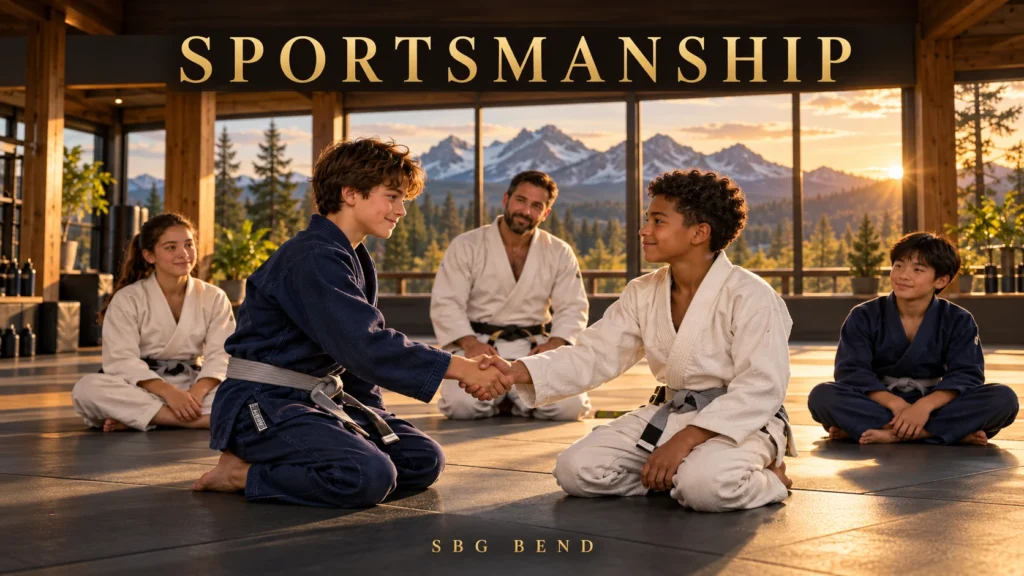
October’s Lifeskill at SBG Bend is Sportsmanship. We are working on the choices that keep effort, honesty, and respect together when a game or a round becomes difficult. Children need help practicing those choices. The adults around them have to practice them, too.
Wanting to win belongs in that picture. So does disappointment. The important question is what we do with those feelings, and how our response affects the people who make training possible.
Help a disappointed child stay connected
In his writing about children and competition, Travis Davison makes room for students to care deeply about losing. He wants them to recognize where they fell short and return to practice, while keeping the disappointment from becoming a belief that they are a failure.
That is a demanding balance for parents and coaches. We can be so eager to fix a child’s feelings that we explain away the loss. We can also rush into a technical lecture when the child needs a moment to recover. Neither impulse gives us much room to listen.
Start with the child in front of you. Check whether they are hurt. Help them settle. A simple “That was hard. I’m here” can be enough for the moment. Tears after a difficult match do not, by themselves, tell us that a child has behaved badly.
When they are ready, bring the conversation back to something they can use: “You kept working from the bottom. Where did you get stuck?” Pick one problem to take to the next class. A child who knows what to practice has somewhere to put their effort.
We can also be clear about conduct. Being upset does not make it okay to insult an opponent or shove a teammate. Stop the behavior, help the child regain control, and support a repair. Their place in the group should feel steady while they learn to handle a hard moment.
The same standard helps adults. We can care about a result, acknowledge a mistake, and come back with a better plan. Our children get to watch us do that.
Let the result be real
In Three Rules for Rolling, Matt Thornton describes a revealing moment: a coach is rolling competitively, a student gains an advantage, and the coach suddenly starts giving instructions. Coaching during a round can be useful. Changing roles at the precise moment you are being beaten can also be a way to hide from what just happened.
That example reaches well beyond black belts. A child can dismiss another child’s success with “I wasn’t trying.” An adult can agree to an easy round, then turn up the intensity when their partner begins doing well. In both cases, the agreement changes to protect the person who dislikes the result.
A more useful response leaves the other person’s achievement intact: “You got past my defense. What did I miss?” We can recognize a gap in our skill without making it a crisis about who we are.
This is where sportsmanship connects directly with SBG’s approach to learning. Aliveness uses timing, energy, and motion to give us feedback from a partner who responds. That feedback only helps if we are willing to acknowledge it. A belt, a confident explanation, or our opinion of ourselves cannot make an escape work. We have to discover what happens and adjust.
For a child, the lesson can be wonderfully plain: follow the game you agreed to play, tell the truth about the result, and let the other person have their success. There will be another turn.
Give your partner a useful challenge
Being a good sport also requires judgment while the round is happening. An older or more experienced student can shut a beginner down so completely that neither person learns much. They can also offer so little resistance that the beginner never discovers what needs work.
Thornton gets specific about this in Notes on Drilling. In a focused escape drill, the partner providing resistance has a job: adjust the challenge so the other person has an opportunity to work. If the escape succeeds easily every time, increase the challenge. If the student cannot begin to solve the problem, ease it and involve the coach. The drill’s purpose guides the resistance.
For our Growing Gorillas, that makes sportsmanship something visible. Listen to the task. Give your partner their turn. Stay within the boundaries the coach sets. An escape drill needs a partner who is paying attention, including when it is somebody else’s turn to improve.
A partner’s safety remains part of the agreement. Release immediately when someone taps or says stop. Ask for a change when the intensity is wrong. Bring a coach in when you need help. Nobody owes another person an unsafe round, and children should never have to choose between being called a good sport and asking for protection.
A good win leaves room for other people
Winning deserves attention, too. A child who worked hard and performed well should be able to enjoy it. The question is whether that enjoyment leaves room for the person who lost.
In Five Traits for Leadership, Thornton points out that gloating winners do little to inspire others. He asks leaders to take pleasure in other people’s progress and use their words to help people keep going. That is a useful standard for a team celebrating a result.
Celebrate your teammate’s success. Acknowledge the opponent. Keep the jokes away from somebody else’s disappointment. When a younger student wins for the first time, give them a chance to enjoy it without immediately explaining why you could have stopped them.
SBG coach John Frankl adds another perspective. In his reflection after the 2017 Masters Worlds, he recognized the years of teaching and partnership behind the few minutes he appeared to compete alone. His account makes the work of a whole community visible inside an individual performance.
That gives a winning child something worth noticing. Who helped them practice? Who gave them a difficult round? Who encouraged them when the technique was confusing? Gratitude becomes specific when they can name a person and what that person contributed.
A medal can belong to one athlete. The work that made it possible usually includes a lot of other people.
Children notice what the adults excuse
A sportsmanship lesson loses credibility when adults exempt themselves. We cannot ask a child to accept correction while treating every correction of our own behavior as an attack. We cannot ask for respect toward an opponent while mocking that opponent from the sidelines.
An SBG Montana report from the 2019 Revolution tournament describes coaches competing alongside their students. Travis Davison explains the value of coaches being honest and vulnerable; Daniel di Stefano describes competing as a chance to demonstrate how to win and lose with sportsmanship. Students could see their coaches face the same uncertainty they were being asked to face.
There are everyday versions of that example. A coach can acknowledge that a drill was poorly explained and reset it. A parent can admit that they got carried away while cheering. An experienced student can thank a newer partner for a correction.
Adults also have a responsibility to intervene. If someone ignores a tap, humiliates another student, or makes training unsafe, the answer cannot be to ask the child on the receiving end for more patience. The coach needs to address the behavior and protect the students.
Respect leaves room to raise a real concern. A parent can ask a coach about a decision and use an event’s process for challenging it. We can be firm and factual without turning officials or another family into targets. Children learn something from how we pursue fairness, too.
Give sportsmanship a job this month
“Be a good sport” becomes easier to understand when a child knows what it looks like. Choose one action to practice, then notice it when it happens.
Before a game or round: listen to the rules, make sure both people understand the task, and help a new partner find their place. A younger child may need a coach to demonstrate the first turn.
During it: give honest effort, take turns, and respond immediately when someone needs to stop. If frustration starts changing how you treat your partner, ask for help and reset.
Afterward: acknowledge the other person and identify something useful. “You kept your balance when I tried to move you” gives a child more to understand than a vague instruction to be respectful. A word, nod, or agreed gesture can acknowledge a partner; the point is care, rather than a forced performance.
Our Growing Gorillas Leadership Team gives these responsibilities practical form. Students practice giving clear coaching cues, reassuring teammates, and understanding match etiquette. Rotating through roles such as athlete, coach, referee, and scorekeeper lets them experience more of what makes a fair match possible. Competition is optional; these are useful ways to contribute in an ordinary class as well.
Keep the same language available at home. During a board game, practice accepting the agreed rule even when it costs a turn. When a sibling succeeds, acknowledge what they did well. If a game ends badly, return to it later and practice a better ending. Skills need opportunities to travel beyond the gym; we should pay attention to whether they actually do.
The next round is something we share
At SBG Bend, we want children to become people others can trust with a challenge. People who give sincere effort, tell the truth about what happened, and take care of the person across from them. That takes repetition, guidance, and adults who are willing to be held to the same standard.
This month, notice the moment when protecting your pride starts to feel more important than learning. Give your partner credit. Help your child through the disappointment. Repair the mistake. Leave the relationship ready for another round.
That is a practical meaning of One Tribe One Vibe. We help make a room where people can care about doing well and trust one another enough to keep trying.
Our Growing Gorillas children’s programs in Bend combine martial-arts training with age-appropriate movement, leadership, and character development. If you would like your child to train with us, get in touch with SBG Bend and we will help you find a starting point.
This is SBG. You’ll be OK.
Sources and further reading
1. SBG — The Gorilla Press, Issue 84: Kisa Davison on Growing Gorillas and Parenting
2. Matt Thornton — Three Rules for Rolling
3. SBG — Philosophy: Truth, Aliveness, and Adaptability
4. Matt Thornton — Notes on Drilling
5. Travis Davison — How to Make Your Biggest Failure Your Greatest Lesson
6. Matt Thornton — Five Traits for Leadership
7. SBG — The Gorilla Press, Issue 92: John Frankl on Masters Worlds
8. SBG Montana — SBG Coaches Set the Bar at Rev 40
9. SBG Bend — Growing Gorillas Leadership Team