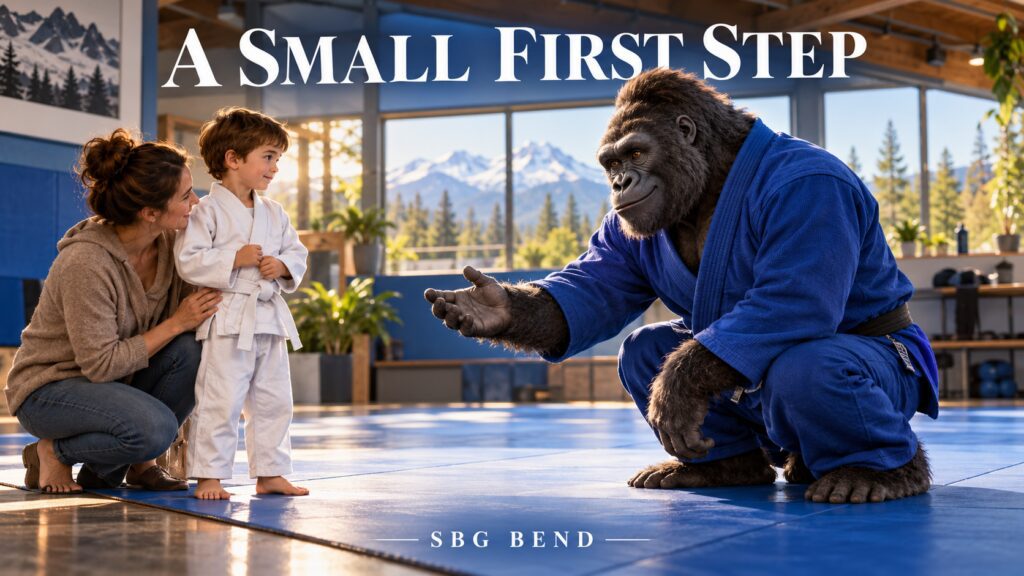
Your child liked the idea of martial arts at home. Now you’re getting ready to leave, and the questions begin: “Will I have to fight someone?” “What if I don’t know what to do?” “Do you have to be good already?”
Before a first class, those questions deserve real answers. A new room, unfamiliar adults and partner activities give a child plenty to figure out. As a parent, you can help by making the next step clear and finding out how the gym introduces beginners.
If you’re exploring kids’ martial arts in Bend, start with a smaller question than whether your child will love it: What would help them understand this first visit?
Find the specific worry
“I don’t want to go” can mean several things. Your child might be worried about getting hurt, making a mistake, meeting a partner or being the only beginner. Ask one simple question and leave room for the answer: “Which part are you wondering about?”
If they struggle to explain, offer a couple of possibilities without turning the conversation into an interview. “Is it meeting people, or not knowing what the class will be like?”
You don’t need to talk them out of the feeling. Try: “We can ask the coach about that before you start.” Avoid promising that everything will be easy or that they’ll definitely love it. You can promise to listen and help them get answers.
Contact the gym before the first visit
A short conversation beforehand gives you useful information and gives the coach context. Describe what your child actually said rather than introducing them with a label such as “our shy one.”
For example: “My child is interested, but they’re worried about working with someone they haven’t met. How do you introduce new children to partner activities?”
Ask about the practical details, too:
- Which class should we book for their age and experience?
- What should they wear and bring?
- When should we arrive, and who should we check in with?
- How do you introduce contact and explain how to stop an activity?
- What is the best introduction if they’re hesitant when we arrive?
SBG Bend’s Growing Gorillas program offers age-grouped children’s and teens’ classes. The program combines Brazilian Jiu-Jitsu with movement education and other developmental activities. Ask the team which group is appropriate for your child, especially at an age-group boundary.
Keep the explanation at home simple
Once you have the details, explain the visit in a few concrete sentences. Tell your child where you’re going, whom you’ll meet and what the coach has told you to expect. If something is still unknown, say you’ll ask together.
Leave a little breathing room around the trip. A rushed departure adds another problem to solve before anyone reaches the mat. Involve your child in an ordinary preparation task, such as filling a water bottle or choosing the clothes the gym recommended.
Keep the first goal small: meeting the coach, understanding an activity or asking a question. Agree on that goal with your child and check that it fits the introduction you’ve arranged. They don’t need to impress anyone at the door.
Understand what a manageable challenge can look like
Martial arts involves learning with another person. That means children eventually need opportunities to respond to a partner who moves and makes choices. Parents should be able to ask how the coach builds toward that challenge.
SBG’s published coaching approach emphasizes fundamentals, understanding why a skill works, technical practice and a playful learning environment. That gives parents a useful lens: can you see what the activity is teaching, and does the child understand the task?
Consider a simplified movement game as an illustration: one child tries to move around a seated partner. First, the partner stays still while the coach explains the goal and boundaries. Later, the seated partner is allowed to turn to keep facing the other child. Now the learner has to adjust their direction and timing. The task has become more demanding without adding a long list of new instructions.
This is the purpose of Aliveness: use a partner’s real responses to find out whether an idea works, then adjust.
The exact activity depends on the class. The useful progression is from understanding a task to testing it with an appropriate challenge. Ask the coach how they choose that challenge for a newcomer and when they change it.
Look for how the coach responds
A child may need a repeated explanation or feel frustrated when an attempt doesn’t work. Pay attention to what happens next. Does the coach make the instruction clearer? Check that the partners understand their roles? Give the child a practical next step?
Useful questions for your own evaluation include:
- Does my child know whom to ask for help?
- Are boundaries and stopping instructions clear?
- Does the coach notice confusion or escalating frustration?
- Are mistakes treated as part of practice?
- Can I raise a concern and get a straightforward answer?
Difficulty alone doesn’t tell you whether a class is a good fit. Look at the task, the response to your child and your child’s own account. Pain, humiliation or ignored requests to stop deserve prompt attention. Speak with the coach rather than asking your child to push through an unresolved concern.
Have a short conversation afterward
Give your child room to settle before asking for a verdict. “What did you try?” or “Was anything different from what you expected?” can start a more useful conversation than “Did you win?”
Notice something specific: “You asked when you weren’t sure what to do.” If an activity bothered them, find out which part and bring that question back to the coach. One visit can give you information without settling every question about the future.
Talk together about whether another visit makes sense and what needs clarifying first. There’s no need to set a deadline for your child to stop feeling nervous.
Plan your child’s first class at SBG Bend
The best next step is a conversation about your child and the introduction that suits them. Explore SBG Bend’s children’s programs, then contact us to ask questions or arrange a free introductory class. Tell us your child’s age, experience and what they’re unsure about so we can discuss where to begin.
Call 541-697-4440 or email hello@sbgbend.com. You can also use our contact form to request a callback or book a free trial class.