A child should be able to go to school, make friends, and walk into a room without wondering whether someone will humiliate or hurt them. When trouble does happen, we want that child to have useful options: recognize the situation, speak clearly, support someone else, get help, and physically defend themselves when necessary.
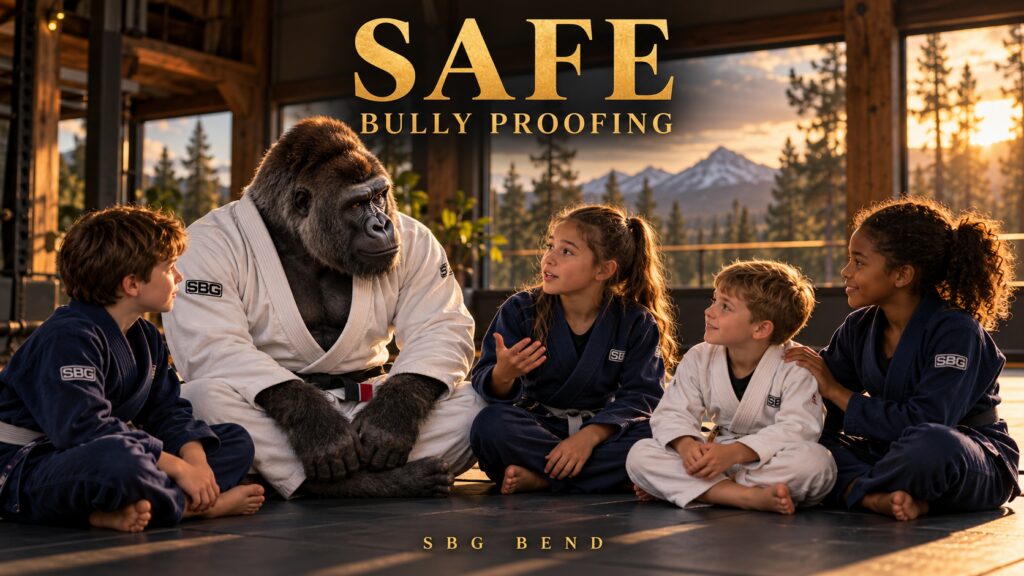
At SBG Bend, we are bringing the SAFE Bully Proofing System into our work with kids. Created by Coach Rich Beaupit of SBG Niagara in St. Catharines, Ontario, SAFE connects practical self-defense with awareness, communication, emotional control, and the responsibility to treat other people well.
Beaupit describes developing the system through more than three decades of teaching in Niagara schools. His public program description emphasizes recognizing problems early, establishing boundaries, and building confidence through discussions, drills, and age-appropriate grappling. In his Gymdesk interview, he explains that the original name means Street Smarts Are For Everyone.
The teaching materials bring that larger purpose into language children can remember. They connect four SAFE commitments with the three R’s of life, the three R’s of bullying, and three levels of aggression. Together, these provide a framework for developing both the ability to protect yourself and the judgment to use that ability responsibly.
Understanding bullying and the responsibility to stop it
Bullying can involve physical aggression, threats, insults, rumors, deliberate exclusion, or online harassment. StopBullying.gov defines it as unwanted aggressive behavior involving a real or perceived power imbalance, with repetition or the potential for repetition. That imbalance can come from size, popularity, group numbers, or access to embarrassing information.
A disagreement between friends and a pattern of intimidation require different responses. Both deserve attention, but labeling every disagreement “bullying” can obscure what is happening and what kind of help a child needs.
Children also do not have to wait for an incident to meet a formal definition before protecting themselves or asking for help. A single assault matters.
Teaching children skills does not transfer responsibility for bullying onto the child being targeted. Adults must take reports seriously, interrupt harmful behavior, and help create safer environments. Confidence, posture, and communication may give a child more options; they do not make that child responsible for someone else’s aggression.
The four SAFE commitments
The SAFE materials organize everyday behavior around four commitments. Each applies to a child who is being targeted, a child witnessing mistreatment, and a child learning to recognize their own harmful behavior.
S means stand up for yourself and others
Standing up begins with recognizing that your boundaries matter. A child can practice saying, “Stop,” “I don’t like that,” or “Give me space,” in a voice another person can hear.
It also means noticing when someone else needs support. That support might be inviting an excluded child to join you, refusing to laugh at an insult, walking with someone to a trusted adult, or speaking up when it is safe to do so.
There is no single performance of bravery. A quiet child who reports what happened has acted. A child who leaves a dangerous situation has made a useful decision. A child who physically protects themselves during an assault has acted to preserve their safety.
A means accept people for who they are
Children differ in personality, ability, background, appearance, and how they communicate. Acceptance means those differences do not determine whether someone deserves dignity or a place in the group.
On the mat, this becomes practical: welcome a new student, work patiently with a partner who learns differently, and respect another person’s boundaries. Acceptance includes respecting a “no” and stopping when a partner asks you to stop.
We can accept a person while holding them accountable for behavior that hurts someone else. Inclusion works when everyone’s safety matters.
F means be friendly to others
Friendliness becomes a skill when children know what it looks like. Learn someone’s name. Invite them into a game. Help a partner understand the task. Notice who is standing alone.
These small actions give children ways to contribute before a conflict begins. They also give bystanders something constructive to do afterward.
Federal guidance on bystanders includes walking with the person being targeted and checking in privately to offer support. Children need options that match their age and the situation; helping someone does not require confronting a dangerous group alone.
E means encourage others to make good choices
Peer influence can support a better decision. A child can say, “Let’s leave,” “That’s enough,” or “Come with me,” when a friend is getting pulled into something harmful.
Encouragement also means refusing to provide an audience for cruelty. Laughing, cheering, forwarding an embarrassing video, or adding another insult can reinforce what is happening.
The useful question is simple: What can I do here that makes someone safer or helps the group make a better choice?
Respect restraint and responsibility
The three R’s of life give children a way to evaluate how they use their growing confidence and physical ability.
Respect means treating partners and peers as people whose safety and dignity matter. In training, it includes listening, following the task, and honoring the tap immediately. Away from the gym, it includes respecting boundaries and differences.
Restraint means controlling your actions so they serve a useful purpose. During an assault, that can include immediate, decisive physical defense. The purpose is to protect yourself, stop the threat, and reach safety. Restraint also means recognizing when the threat has ended and stopping then.
Responsibility means owning what you do and say. A child who hurts someone needs to acknowledge it and change the behavior. A child who witnesses mistreatment can seek help. Adults have responsibility for supervision, intervention, and follow-through.
These principles belong together. Physical skill gives a child more capacity to act; respect, restraint, and responsibility help guide that action.
Ridicule rejection and retaliation
The three R’s of bullying describe a pattern children can understand: ridicule can leave someone feeling rejected, and that hurt can turn into a desire to retaliate.
This is a useful conversation about consequences. “We were just joking” does not tell us how the other person experienced the joke. A group can think it is having fun while one child feels isolated and humiliated.
It also gives children language for their own feelings: “I felt left out,” “I was embarrassed,” or “I wanted to get even.” Naming those feelings creates an opening to consider what to do next.
The pattern is a teaching aid, rather than a complete explanation of bullying. Bullying has different motives and forms. Many children who experience rejection never retaliate, and being hurt does not excuse hurting someone else.
The opportunity is to interrupt the pattern: stop the ridicule, include the person being excluded, seek adult support, and help an upset child choose a response that protects them without creating another victim.
Recognizing aggression and responding effectively
The materials describe mental, verbal, and physical aggression. This framework encourages children to notice a developing problem and consider their options early.
Real encounters do not always follow that order. Physical aggression can happen suddenly, and verbal or social bullying can remain harmful without becoming physical. Children need permission to respond to what is actually happening.
Mental means noticing the situation
The materials use the idea of an “interview” to describe someone testing another person’s reaction through their look or behavior.
We can use that idea to teach observation: Is someone deliberately following me? Blocking my path? Moving into my space? Are several people gathering around?
A look alone does not establish hostile intent. Children should consider behavior and context, and they should not have to maintain eye contact to demonstrate confidence. The practical aim is to notice available space, nearby support, and an opportunity to leave or get help.
Verbal means using communication and boundaries
If someone starts taunting, threatening, or provoking, a child can practice a clear boundary, avoid being drawn into an argument, and move toward safety.
“Stop. Back up.” is easier to remember than a clever comeback. An adult report can be specific: “They keep blocking my way and threatening me. I need help.”
Feeling afraid does not mean a child has failed. A useful response can happen with a shaky voice or a racing heart. The goal is to make a workable decision while feeling what you feel.
Physical means protecting yourself
When a child is assaulted, they can act immediately to protect themselves. They do not need to finish a script, remain still, or wait for an adult’s permission.
Depending on the situation, protection may require shielding themselves, escaping a hold, regaining their balance, or using trained physical skills to stop the aggression and create an opportunity to get safe. Walking away is useful when it is available; effective self-defense helps when it is not.
The distinction children need to understand is between protecting themselves from a threat and pursuing punishment after that threat has ended. Our coaching should prepare them to recognize both.
How SBG turns ideas into usable skills
SBG’s approach begins with a question: How do we know this works?
That is the practical meaning of epistemology: how we establish what we know. SBG’s core philosophy connects truth, aliveness, and adaptability. In physical training, aliveness involves timing, energy, and motion: a partner moves and responds, so the student must adapt.
A cooperative demonstration can introduce a skill. Practice with appropriate resistance helps reveal whether the student can use it. Feedback gives the coach a reason to adjust the task, the difficulty, or the explanation.
This also places a responsibility on us. A successful drill shows what a child can do in that drill. Whether skills carry into school and everyday life requires attention to what happens there. We should be willing to change our teaching when that feedback shows a child needs something different.
Introduction isolation and integration
Matt Thornton’s I-Method gives that learning process a structure.
Introduction: Explain the skill and its purpose. Give the child a clear starting point and enough support to understand it.
Isolation: Practice a manageable part of the problem. For physical skills, add appropriate, progressive resistance so the child learns to respond to another person.
Integration: Put that skill into a broader task where the child has to recognize an opportunity and choose a response.
We can apply this progression to SAFE’s communication and decision-making lessons as well. That application should be deliberate and sensitive to the child; a social scenario is a learning task, not an invitation to humiliate someone.
What a SAFE practice scenario can look like
A lesson might begin with a coach explaining personal space and demonstrating a short boundary statement. Children first practice it in a calm, cooperative setting.
Next, the coach varies one element: where the partner stands, whether the partner responds to the boundary, or where the child can move to find support. The child practices recognizing the situation and choosing an action.
A later task can connect recognition, communication, movement, and an adult report. Physical defense can be practiced separately and then connected to a clearly defined scenario at a level the child can manage.
Practice needs clear rules, supervision, and an immediate way to stop. Difficulty should increase with readiness. A child should understand the task and have room to succeed, pause, and try again. Overwhelming a child makes it harder to learn what the exercise was meant to teach.
Afterward, useful questions include: “What did you notice?” “What helped?” “When could you leave?” and “What would you tell an adult?” Those answers reveal understanding that reciting a slogan cannot.
What scientific research supports
Research gives us good reasons to teach several skills emphasized by SAFE. It also helps us keep our claims proportionate: the studies below evaluated other interventions, so their results do not establish an effectiveness rate for SAFE or for SBG Bend’s classes.
Social and emotional skills can be taught
A 2011 meta-analysis by Durlak and colleagues examined 213 school-based social and emotional learning programs involving 270,034 students. Compared with control groups, participants showed improvements in social and emotional skills, attitudes, behavior, and academic performance.
For SAFE, the connection is that communication, awareness of emotions, and constructive behavior deserve explicit teaching and practice. We should give children examples, opportunities to try, and feedback. Simply telling a child to “be respectful” leaves much of the learning unexplained.
Peer behavior can help change the environment
A 2016 randomized experiment by Paluck, Shepherd, and Aronow involved 56 schools and 24,191 students. An intervention encouraging selected students to take a public stand against conflict reduced disciplinary reports of student conflict by about 30 percent over one year compared with control schools.
That outcome concerned reported school conflict, rather than a SAFE program or a measure of all bullying. Still, it supports taking peer influence seriously.
The practical connection to SAFE’s friendliness and encouragement commitments is clear: children can help establish what their group welcomes, rewards, and refuses to join.
Bullying prevention benefits from organized intervention
A 2021 Campbell systematic review by Gaffney, Ttofi, and Farrington synthesized 100 evaluations. Its summary reported average reductions of roughly 18–19 percent in bullying perpetration and 15–16 percent in victimization, with substantial variation between studies.
A separate randomized evaluation of the KiVa program involved 78 schools and 8,237 children in grades four through six. It found reductions in bullying and victimization after nine months of implementation.
These findings support organized prevention and intervention. Our practical conclusion is that a gym should work alongside families and schools. A child’s individual skills matter within a wider environment that adults must help manage.
Martial arts can support some aspects of self-regulation
A 2022 randomized trial by Ng-Knight and colleagues studied an 11-week introductory taekwondo course with 240 children aged seven to eleven. Children in the intervention showed improvements in attentional control and executive attention, along with fewer teacher-rated conduct problems.
The study did not find improvements across every measure, including several measures of inhibition, impulsivity, and prosocial behavior. It also studied taekwondo, rather than Brazilian Jiu-Jitsu or SAFE.
This is encouraging evidence for specific benefits under specific conditions. It supports taking the structure and content of instruction seriously, while avoiding a blanket promise that martial arts automatically produces better behavior.
Practice design matters
In their 2011 paper on representative learning design, Pinder and colleagues describe a framework for designing practice that preserves important relationships between information and action in the performance environment.
This is a conceptual connection to SBG’s training approach, rather than a trial proving an anti-bullying effect. It gives us a useful coaching question: Does our practice ask the child to notice and respond to the things that matter?
For physical self-defense, that means responding to movement and resistance. For a SAFE scenario, our application is to include decisions about space, communication, available help, and when physical protection is necessary.
What parents can reinforce at home
Families can give these lessons a familiar place outside the gym.
Ask about specific actions: “Who did you include today?” “Did anyone need help?” “What could you do if a friend starts making fun of someone?” Specific questions make it easier to connect a value with behavior.
Practice brief boundary statements without turning every conversation into a confrontation. Help your child identify trusted adults and explain how to make a clear report. If the first adult does not help, the child should keep telling another trusted adult, while caregivers follow up directly.
If your child describes bullying, listen, thank them for telling you, and record the details needed to address it. Avoid making the conversation a test of whether they sounded confident enough. Help them develop a plan with the adults responsible for the setting.
For online incidents, that plan can include preserving messages or screenshots, avoiding forwarding harmful content, and involving a trusted adult.
If physical aggression occurs, reinforce that your child can protect themselves. Talk afterward about what happened, what helped them become safe, and what adult follow-through is needed. Their safety comes first.
Bringing SAFE to SBG Bend
We are bringing SAFE to SBG Bend because its lessons connect with the kind of training community we want to build: children who can protect themselves, treat others well, and contribute when someone needs support.
On the mat, that means practicing physical skills with purpose and control. Around the mat, it means welcoming a partner, respecting a boundary, speaking up, and taking responsibility for a mistake.
Progress should become visible in those actions. Can a child recognize a problem? Set a boundary? Seek useful help? Defend themselves in an appropriate training task? Notice someone being excluded and make room for them?
Those questions keep the focus on what children can understand and do. They also keep us learning as coaches.
SAFE gives us a shared language. SBG’s teaching approach gives us a way to practice, observe, and adapt. Families, schools, and coaches give children the support to use those skills beyond the gym.
One Tribe One Vibe.
Sources and further reading
1. SBG Niagara — SAFE Bully Proofing System
2. SBG Niagara — Coach Rich Beaupit and the origins of SAFE
3. Gymdesk Originals — Interview with Coach Rich Beaupit, April 22, 2026
4. StopBullying.gov — What Is Bullying
5. StopBullying.gov — Bystanders to Bullying
6. SBG — Philosophy and the principles of truth, aliveness, and adaptability
7. Matt Thornton — Notes on Drilling and the I-Method
8. Durlak et al. (2011) — The Impact of Enhancing Students’ Social and Emotional Learning
9. Paluck, Shepherd, and Aronow (2016) — Changing Climates of Conflict
11. Kärnä et al. (2011) — A Large-Scale Evaluation of the KiVa Antibullying Program
12. Ng-Knight et al. (2022) — Does Taekwondo Improve Children’s Self-Regulation