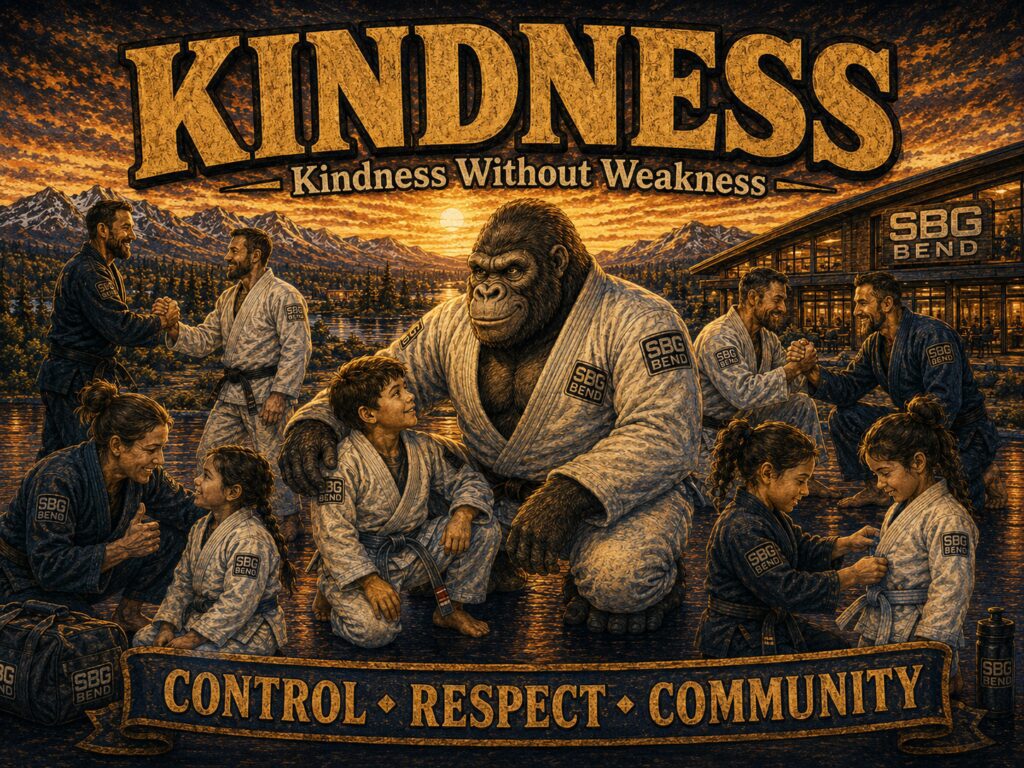
This month’s Lifeskill is Kindness.
Kindness sounds simple enough. Be nice. Help people. Share. Don’t be a menace in the group chat. Cool.
But at SBG Bend, kindness goes deeper than basic politeness.
Kindness is one of the hidden skills underneath every good training partner, every healthy team, every good coach, and every strong community.
Our Growing Gorillas curriculum defines it simply:
Kindness is giving to those in need without expecting anything in return.
That sounds straightforward until another human being gets involved.
It is easy to be kind when everyone agrees with you, nobody is irritating you, you are well-rested, your training partner weighs exactly what you weigh, and nobody has just smashed your face into the mat with shoulder pressure.
That is laboratory kindness.
We are more interested in the version that survives outside the laboratory.
At SBG Bend, kindness does not mean being passive. It does not mean avoiding conflict, pretending everything is fine, letting people walk over your boundaries, or lowering standards so nobody ever feels uncomfortable.
And it definitely does not mean becoming a human throw pillow in a rashguard.
Real kindness requires strength.
It takes control to challenge someone without hurting them. It takes confidence to include a beginner without patronizing them. It takes courage to speak when everyone else is laughing. It takes humility to apologize before defending yourself. It takes discipline to tell someone the truth without trying to wound them.
And sometimes it takes considerable restraint not to cross-face your favorite training partner into another dimension.
That is the kind of kindness we are working on this month.
Kindness has to survive contact with reality
SBG has always been built around a simple but uncomfortable idea: what we want to be true does not determine what is actually true.
Our philosophy begins with Truth, Aliveness, and Adaptability: SBG Philosophy: Truth, Aliveness, Adaptability .
Aliveness gives us a method for discovering what actually works. Training includes timing, energy, and motion. Another person moves, reacts, resists, and forces us to adapt: Matt Thornton: Why Aliveness .
That is normally discussed as a martial-arts principle.
It is also a pretty useful test for character.
It is easy to call yourself patient when nobody is testing your patience.
It is easy to call yourself respectful when you are winning.
It is easy to call yourself generous when generosity costs nothing.
It is easy to call yourself kind when kindness requires no courage.
Pressure gives us information.
The mat does this beautifully because another person immediately exposes the difference between what we intend to do and what we are actually capable of doing.
You may intend to be a good training partner.
Cool.
- Can you control your weight when the person underneath you is forty pounds lighter?
- Can you give a new student enough resistance to learn without either smashing them or lying to them?
- Can you catch a submission without ripping it?
- Can you lose a round without turning the next five minutes into a revenge documentary?
- Can you tell your partner, “That was a little too hard,” without hostility?
- Can you hear the same thing without becoming defensive?
Now we are testing kindness instead of merely discussing it.
Our teen Lifeskill curriculum puts this plainly:
Kindness is not lowering the intensity of every round. It is controlling your power well enough to challenge a partner without using them to prove something.
That is kindness with teeth.
Control is strength
One of the first things a good martial artist learns is that possessing power and controlling power are different skills.
A beginner often has two speeds: nothing and DEATH MATCH.
Experience creates more gears.
A skilled grappler can roll with:
- a first-day white belt,
- another advanced student,
- a smaller teenager,
- a competitor preparing for a tournament,
- or somebody returning from an injury,
and give each person a useful round.
The technique may be the same.
The intent may be the same.
But the application changes.
That is adaptability, and in a training room it is also kindness.
Kindness does not require pretending your partner succeeded when they did not. Fake resistance teaches fake lessons.
It means giving them the problem they actually need.
Sometimes the kind thing is to slow down.
Sometimes the kind thing is to increase resistance.
Sometimes the kind thing is to say, “Nope, that one isn’t going to work. Try again.”
The question is not:
“How do I make this person comfortable?”
The better question is:
“What does this person need from me right now to become more capable?”
That is a very different standard.
The I-Method is surprisingly good at teaching kindness
SBG’s teaching methodology gives us a practical framework for this.
The I-Method moves through:
Introduction – Isolation – Integration
Skills are first introduced clearly, then placed into a focused problem with resistance, and eventually returned to the larger game: Matt Thornton: Notes on Drilling .
Matt Thornton’s coaching model also emphasizes fundamentals, the natural order in which they arise, and understanding why things work instead of simply memorizing movements: Matt Thornton: Coaching the SBGi Way .
Notice what that requires from the people in the room.
1) Introduction: give people room to learn
During Introduction, kindness looks like patience.
Let your partner learn. Communicate. Pay attention.
Do not use someone’s first repetition as an opportunity to demonstrate how impressively impossible you are to move.
You are not helping them learn.
You are auditioning for a tournament that exists exclusively inside your skull.
2) Isolation: calibrate resistance
During Isolation, kindness becomes calibration.
Give meaningful resistance.
Let the problem be real.
Do not give away the answer, but do not turn a learning drill into the finals of the Mundials either.
A useful training partner can:
- increase resistance when the problem is too easy,
- decrease resistance when learning has completely stopped,
- follow the constraints of the drill,
- challenge without overwhelming,
- and adapt as their partner improves.
That is kindness expressed through good training.
3) Integration: cooperate inside competition
During Integration, kindness becomes cooperation inside competition.
You are trying to win.
Your partner is trying to win.
Both of you are also participating in the other’s education.
That is one of the wonderful contradictions of Jiu-Jitsu:
Your opponent can genuinely try to stop you while simultaneously helping you become better.
Nobody develops skill alone.
Every person on the mat is part student, part opponent, and part learning environment.
Kindness does not mean rescuing people
There is another trap here.
Sometimes helping someone feels so good that we accidentally rob them of the thing they actually need:
The opportunity to struggle.
Our teen Lifeskill curriculum describes this beautifully. Rescuing can feel kind, but it may steal another person’s reps and responsibility.
Good support gives tools, time, and encouragement while leaving ownership with them.
That fits almost perfectly with SBG’s coaching philosophy.
A coach could simply give you every answer.
A good coach often gives you a better problem.
- Ask a question.
- Change the parameters of a drill.
- Restrict one option.
- Increase the resistance.
- Let you fail.
- Then help you figure out why.
Parents know this problem too.
So do teachers.
So do managers.
Doing everything for another person can feel compassionate while quietly communicating:
“I don’t believe you can do this.”
Real kindness says:
“I will help you. I will not steal your opportunity to become capable.”
Inclusion does not require lowering standards
The same principle applies to inclusion.
A new student walks through the door knowing nobody.
Everyone else already understands where to put their shoes, how class begins, who normally partners together, what “shrimp” means, why grown adults are voluntarily strangling each other, and approximately fourteen other unwritten rules nobody remembers learning.
It is easy for an established group to forget what being new feels like.
Kindness means noticing.
- Introduce yourself.
- Learn the person’s name.
- Invite them into the group.
- Explain the routine.
- Be their partner.
- Give them enough context that they have a legitimate opportunity to participate.
But do not confuse inclusion with pity.
Our teen Lifeskill curriculum makes the distinction explicit:
Inclusion is not pretending skill differences do not exist. It is giving someone access to instruction, context, and a real opportunity to meet the standard.
That matters.
We do not help people by pretending the standard is meaningless.
We help them reach it.
Kindness can say no
This is especially important for teenagers, but plenty of adults could use the reminder too.
Boundaries can be kind.
Saying yes because you are afraid of disappointing someone is not necessarily kindness.
Allowing someone to repeatedly disrespect you is not kindness.
Letting an unsafe training partner continue hurting people because you do not want an awkward conversation is definitely not kindness.
A clear boundary protects you while giving another person honest information.
Kindness can sound like:
- “I can’t do that.”
- “Please stop.”
- “Let’s slow this round down.”
- “I’m not comfortable with that.”
- “That wasn’t okay.”
- “You need to talk to Coach.”
Those are not failures of kindness.
Sometimes they are kindness doing the difficult part of its job.
Honest does not have to mean harsh
Kindness also does not require fake agreement.
Truth helps when it is specific, respectful, and useful.
“I’m just being honest” is not a free pass to humiliate someone.
There is a difference between useful feedback and using “honesty” as an excuse to demonstrate your superiority.
Before giving feedback, useful questions include:
- Is what I am about to say true?
- Is it useful?
- Am I the right person to say it?
- Should I say it privately?
- Am I trying to help, or am I trying to win?
A simple structure works surprisingly well:
What you noticed. Why it matters. One useful next step.
That is honesty with a purpose.
Kindness does not mean avoiding hard competition
We also do not want to accidentally teach children – or adults – that being kind means being afraid to compete.
Compete.
Try to win.
Develop skill.
Push yourself.
Take the shot. Pass the guard. Finish the match.
Kindness does not require making yourself smaller so someone else never has to experience losing.
Our teen curriculum summarizes it perfectly:
Compete hard. Respect harder.
The opponent trying to beat you is also revealing holes in your game that you might never discover by yourself.
There is a huge difference between:
“I want to perform at the absolute best of my ability.”
and
“I need your failure to prove something about my value.”
The first one creates great competitors.
The second one creates people nobody wants to train with.
Competition and kindness are not enemies.
Ego and kindness usually are.
Sometimes kindness has a social cost
The easy version of kindness is helping someone when everybody approves.
The harder version happens when the room does not.
Someone becomes the joke in a group chat.
A new kid is being excluded.
A teammate gets mocked after losing.
Somebody keeps targeting the same person because everyone laughs.
Now kindness may cost status.
Our teen material calls this:
“Speak Up When It Costs.”
It does not demand some cinematic monologue.
Sometimes courage is:
- “Drop it.”
- “Not cool.”
- changing the subject,
- sitting next to the person being excluded,
- refusing to forward the screenshot,
- or getting an adult who can actually help.
That is worth teaching because children eventually become adults, and adults encounter the same problem with better vocabulary and more expensive clothing.
Culture is built out of thousands of tiny decisions about what people reward, ignore, tolerate, and interrupt.
Which brings us back to the tribe.
One Tribe, One Vibe is not decorative
SBG’s “One Tribe, One Vibe” idea matters because martial arts are fundamentally cooperative even when they are competitive: What Is SBG? .
You cannot become good at Jiu-Jitsu by yourself.
You need people willing to teach you.
People willing to resist you.
People willing to let you make mistakes.
People willing to keep you safe.
People willing to tell you when something is wrong.
People willing to return tomorrow so you can do the whole ridiculous process again.
Community is not something that exists alongside the curriculum.
Community is part of the curriculum.
A healthy room makes better athletes because students can:
- experiment without humiliation,
- fail without being discarded,
- compete without becoming enemies,
- ask questions without worrying that curiosity is weakness,
- and challenge one another without turning every round into an ego contest.
Kindness helps create that room.
Not softness.
Not fake positivity.
Useful, honest, disciplined kindness.
Kids need repetitions, not posters
This is why we spend time on a monthly Lifeskill in our Growing Gorillas classes.
We do not expect a six-year-old to become kind because an adult delivers a breathtaking twelve-minute lecture on moral philosophy while thirty children stare longingly at the crash pad.
Character needs reps too.
For our youngest students, August’s lessons are deliberately concrete:
- Use your hands to help instead of hurt.
- Help your partner stand up.
- Say something kind.
- Ask someone to be your partner.
- Give another child a turn.
- Notice when somebody needs help.
Simple behaviors.
Repeated often.
As children get older, the problems become more complicated:
- Can you include someone you do not know?
- Can you tell the truth without humiliating someone?
- Can you compete hard and still respect the person who beat you?
- Can you protect a boundary without attacking back?
- Can you apologize without immediately explaining why the thing you did was technically somebody else’s fault?
- Can you help without taking control?
- Can you be patient with your family when nobody is handing out stripes for it?
That progression matters because “be kind” is too vague to train.
Specific behavior can be practiced.
Practiced behavior becomes habit.
Habit eventually becomes character.
That is why our Growing Gorillas program is about more than martial-arts technique: SBG Bend Children’s Programs .
Our Leadership Team takes those ideas further through coaching, communication, service, healthy habits, reflection, and helping less-experienced students: Growing Gorillas Leadership Team .
Role models matter because capability creates responsibility
For our Juniors, one of the examples in this month’s curriculum is John Cena and his work with Make-A-Wish.
There is a reason that example works.
Cena did not help people because he lacked ambition, competitiveness, fame, money, or strength.
He used the things he had acquired to benefit people who needed them.
That gives kids a useful way to think about kindness:
What can I do with what I have?
- Maybe you are stronger. Help somebody learn safely.
- Maybe you understand the technique. Teach instead of showing off.
- Maybe you already have friends. Invite the new kid over.
- Maybe you are older. Set the example.
- Maybe you made the mistake. Repair it.
Strength is useful.
Skill is useful.
Confidence is useful.
Leadership is useful.
Kindness helps determine what we do with them.
Repair before you defend
Kindness also shows up after we screw something up.
Intent matters.
Impact matters too.
If you trained too hard, broke trust, made a cutting comment, missed a commitment, or accidentally hurt someone, the first instinct is often to explain.
- “I didn’t mean to.”
- “That’s not what I was trying to say.”
- “You misunderstood me.”
Maybe all of that is true.
But immediately defending yourself can communicate that protecting your image matters more than understanding what happened.
A stronger response is:
- Say what you did.
- Acknowledge the impact.
- Apologize clearly.
- Say what you will do differently.
Something as simple as:
“I did ____. It affected you ____. I’m sorry. Next time I will ____.”
That is not weakness.
That is accountability with another human being in the equation.
Kindness at home counts too
It is easy to be respectful where you get credit.
Home is often the harder test.
We are sometimes more patient with strangers than with the people we actually love.
At home, kindness can look like:
- handling a shared chore without being asked seventeen times,
- helping a younger sibling,
- not using your worst tone just because your family will probably forgive you,
- noticing the invisible work that keeps a household functioning,
- putting your phone down when someone is talking to you,
- and checking on somebody without needing credit for doing it.
Character is what happens when nobody is handing out stripes.
Self-kindness is discipline
There is one last person who can be surprisingly difficult to treat with kindness:
Yourself.
And here again, we need to be careful with definitions.
Self-kindness is not declaring every impulse healthy.
It is not avoiding difficult things.
It is not inventing seventeen reasons why nothing is ever your responsibility.
Our teen Lifeskill curriculum defines self-kindness much more usefully:
Tell yourself the truth without contempt, recover intelligently, ask for help when necessary, and return responsibly to the work.
That is an athlete’s version of self-kindness.
“I suck” is not useful coaching.
“I lost inside position, got flattened, and stopped framing” is information.
“I’ll never be good at this” is not useful coaching.
“I don’t understand this position yet. I need more reps” is.
One attacks identity.
The other identifies a problem and gives you somewhere to go.
Interestingly, that brings us right back to last month’s Lifeskill.
Personal responsibility without kindness can become self-contempt.
Kindness without personal responsibility can become avoidance.
Put them together and you get something much healthier:
Tell the truth. Own your part. Treat yourself and other people like they are worth helping. Then get back to work.
Leadership is kindness at scale
The final lesson in our teen curriculum is called Set the Tone.
It makes a point that applies to every coach, parent, teacher, business owner, older sibling, higher belt, and team captain:
Leadership is not a title.
What you tolerate, repeat, reward, and model becomes culture.
Kind leaders do not eliminate standards.
They maintain standards, share the work, and create an environment where other people can improve.
That might be the most SBG interpretation of kindness possible.
A strong tribe does not require everyone to be identical.
It requires people willing to make each other better.
- Sometimes that means encouragement.
- Sometimes correction.
- Sometimes protection.
- Sometimes resistance.
- Sometimes an invitation.
- Sometimes a boundary.
- Sometimes an apology.
- Sometimes shutting up and letting somebody figure the problem out.
The method changes.
The principle does not.
The bottom line
Kindness is not weakness.
Weakness cannot reliably protect another person.
Kindness requires enough strength to control yourself.
Enough confidence to tell the truth.
Enough humility to listen.
Enough courage to intervene.
Enough awareness to notice who needs help.
Enough discipline to maintain boundaries.
Enough patience to let someone struggle.
Enough generosity to use your ability for something beyond yourself.
On the mat, that makes better training partners.
In competition, it makes better athletes.
At home, it makes better family members.
For children, it becomes the foundation for leadership.
And across an entire gym, it becomes culture.
One Tribe. One Vibe.
So this month, do not just try to “be nice.”
Do something useful:
- Notice someone.
- Help them up.
- Give them a good round.
- Tell the truth without trying to hurt.
- Include the new person.
- Respect the opponent.
- Own the mistake.
- Protect the boundary.
- Share what you know.
- Speak when silence would be easier.
And when you are the person struggling, give yourself enough kindness to learn instead of wasting the lesson beating yourself up.
That is kindness without weakness.
One useful action at a time.
Want to train kindness the SBG way?
Come experience SBG Bend.
We train Brazilian Jiu-Jitsu, MMA, striking, wrestling, Judo, fitness, and age-specific Growing Gorillas programs using SBG’s principle-driven, Alive approach to learning.
Whether you are an experienced martial artist, a parent looking for the right environment for your child, or someone who has never stepped onto a mat before, you are welcome here.
This is SBG. You’ll be OK.
Because kindness is not something we put on a poster.
It is something we practice.
Sources (for the nerds and the skeptics)
- SBG Philosophy: Truth, Aliveness, Adaptability
- SBG: What Is SBG?
- Matt Thornton: Why Aliveness
- Matt Thornton: Coaching the SBGi Way
- Matt Thornton: Notes on Drilling
- SBG Bend: No Ego, No Problem
- SBG Bend: Children’s Programs
- SBG Bend: Growing Gorillas Leadership Team
- Growing Gorillas: Philosophy and Objectives