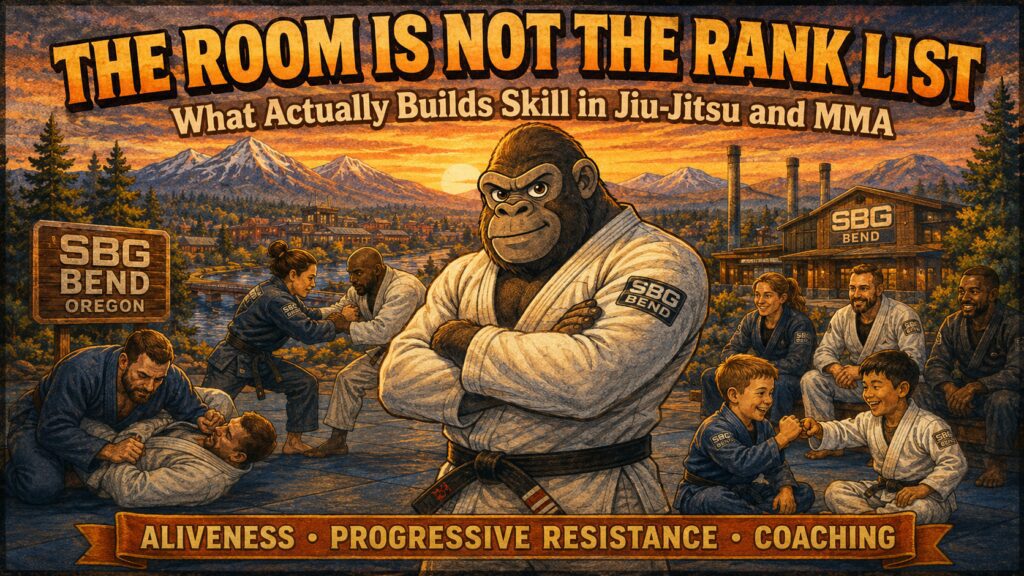
In combat sports, we often use visible things as shortcuts for quality.
How many black belts are in the room?
How many competitors train here?
How hard does the kids class look?
How many rounds are people doing?
How many people can beat me?
Those questions are understandable. They are not useless. But they are incomplete.
A better question is:
Does the training environment create alive, representative, progressively resistant problems that the athlete can solve, fail at, adjust to, and integrate?
That question matters more than belt count, highlight reels, or how intense a class looks from the wall.
Because skill is not built by proximity to rank. Skill is built by repeated exposure to the right problem, at the right level of resistance, with the right feedback, inside a culture that lets people train consistently.
That is not just an SBG idea. That is where SBG methodology and modern sport science point in the same direction.
Aliveness is the standard
SBG’s core principle is Aliveness. Matt Thornton defines Aliveness as training with timing, energy, and motion. If movement, timing, or real resistance is missing, then the training may teach choreography, but it is not teaching functional skill. Matt Thornton: Why Aliveness . That distinction is everything. Jiu-Jitsu and MMA are not static technique demonstrations. They are interaction sports. The athlete is always dealing with another person’s posture, pressure, grips, rhythm, balance, reactions, and intent. You do not learn timing from dead reps alone. You do not learn pressure without pressure. You do not learn decision-making without decisions. But Aliveness does not mean chaos. It does not mean every round is a war. It does not mean kids should train like miniature professionals. It does not mean adult students should only roll with people who can smash them. Aliveness means the training contains real timing, real energy, and real motion, scaled to the athlete and the task. That is where coaching begins.The I-Method is a coaching loop, not a belt ladder
SBG’s I-Method is: Introduction → Isolation → Integration Introduction gives the athlete the concept, movement, position, relationship, or tactical idea. Isolation puts that idea into an alive, constrained mini-game with progressive resistance. Integration returns the skill to the larger game, where the athlete must recognize when and how it appears naturally. Matt Thornton describes the I-Method as SBG’s starting point for coaching. Introduction establishes mechanical correctness and understanding. Isolation is the drilling stage. Integration is where the material is put back into the larger context of BJJ, MMA, self-defense, or whatever game is being trained. Matt Thornton: Notes on Drilling . The important point is this: The I-Method is not a beginner-to-advanced ladder. It is a recursive coaching loop. It can happen around a single frame, a grip break, an underhook, a guard-retention problem, a takedown entry, a cage-wrestling exchange, a striking exit, or an entire fight strategy. You introduce the problem. You isolate the problem alive. You integrate it back into the whole. Then you observe what breaks and begin again. That loop is how mechanics become timing. That loop is how timing becomes skill. That loop is how skill becomes adaptable.Isolation is where most skill is built
Many gyms still follow a simple structure:- show technique,
- do repetitions,
- roll hard.
- Can you recover guard while the top person’s only job is to deny your knee line?
- Can you pass while your partner’s only goal is to retain inside position?
- Can you escape mount while your partner gives progressive pressure?
- Can you wrestle up only after winning the underhook?
- Can you strike safely after winning position?
- Can you exit the cage while the other person applies forward pressure?
Progressive resistance beats maximum resistance
One of the most important coaching errors in martial arts is confusing harder with better. Hard training has a place. Competition rounds have a place. Sparring has a place. Pressure testing has a place. But maximum resistance is not automatically maximum learning. Motor-learning research has a useful concept called the challenge point framework. The basic idea is that learning depends on the relationship between the difficulty of the task and the ability of the performer. If the task is too easy, there is not enough useful information. If the task is too hard, the athlete cannot interpret the information well enough to adapt. The useful zone is not maximum difficulty. It is optimal difficulty. Guadagnoli & Lee: Challenge Point Framework . Anyone who has trained for more than ten minutes has felt this:- If a student succeeds every time, the drill is too easy.
- If a student fails every time, the drill is too hard.
- If a student succeeds, fails, adjusts, succeeds again, gets denied, solves a new layer, and slowly owns the position under increasing pressure — now we are cooking.
The partner is not the program
Training partners are important. Nobody serious denies that. Higher belts can provide depth, pace, pressure, precision, and consequences. They can expose mistakes that lower-level partners may not see. They can model what good movement looks like. But a higher belt is not magic. A black belt who cannot calibrate resistance, follow constraints, or train safely may be a worse learning partner than a blue belt who can give the exact pressure needed for the drill. A lower belt is not useless to an advanced athlete. They are only useless if the advanced athlete is training without purpose. A blue belt may not challenge a purple belt in open rolling if the purple belt is allowed to do whatever they want. Fine. That is not a serious argument against the room. That is an argument for better training design. Change the constraint and the room changes:- Start the advanced student in bad position.
- Make them work only their weak side.
- Remove their favorite grip.
- Force them to win by position before submission.
- Make them pass without standing.
- Make them escape without using their preferred frame.
- Make them wrestle up only after recovering inside position.
- Give the other person the first grip, first angle, or first positional advantage.
- Reset every time the advanced student defaults to their A-game.
This is also modern sport science
Sport science uses different language, but the point is familiar. Representative learning design argues that training should preserve the important information and actions from the real performance environment. In other words, practice should look and feel enough like the actual task that the skill transfers. Representative Learning Design and Functionality of Research and Practice in Sport . A 2024 paper on ecological dynamics in MMA makes the combat-sport version of the same argument. The authors, including SBG Athens coach Adam Singer, argue that MMA coaches should design alive and representative training sessions, manipulating constraints so skilled behavior can emerge for athletes of all levels. Applying an Ecological Dynamics Framework to MMA . That is a very academic way of saying something SBG has said for decades: Don’t just show moves. Create alive problems. The coach is not merely a dispenser of techniques. The coach is a designer of environments. The room is not just a collection of bodies. The room is a learning system.Fundamentals are not beginner material
Another common mistake is thinking fundamentals are what beginners do before they get to the advanced material. That is backwards. Fundamentals are the material. The advanced game is fundamentals expressed with better timing, better feel, better posture, better decision-making, better transitions, better emotional control, and better integration. Thornton’s SBG coaching model emphasizes core fundamentals, the natural order in which those fundamentals arise, and why they arise that way. He argues that teaching core principles allows athletes to develop their own style rather than merely copying the coach’s personal game. Coaching the SBGi Way . This matches the “fundamentals aren’t beginner moves” idea we hammer in our own content: Fundamentals in BJJ: What They Really Mean (and Why They Matter at Every Level) . An advanced athlete does not outgrow mount escapes, guard retention, posture, underhooks, base, pressure, distance, grip fighting, or breathing. They revisit those things under sharper constraints. The beginner may be learning the basic shape. The advanced athlete may be learning the same relationship under fatigue, speed, score, strikes, cage position, time pressure, or against a specific style. Same fundamental. Different constraint. That is not remedial training. That is advanced training.Belt density is a weak proxy for training quality
A room full of upper belts can be excellent. It can also become lazy. If the training is mostly unconstrained rolling, ego rounds, and people repeating what they already do well, the rank density may look impressive while the learning environment is inefficient. Conversely, a room with a wide range of experience levels can be extremely powerful when the coach knows how to use the room. Different ranks provide different kinds of information:- Newer students provide unpredictability and honest non-expert reactions.
- Blue belts provide reliable resistance and enough technical awareness to follow constraints.
- Purple belts provide tactical adaptation and deeper positional problems.
- Brown and black belts provide refinement, diagnosis, modeling, and high-consequence feedback.
Hard rounds matter, but they are not the whole method
Competitors need hard rounds. They need pressure. They need bad positions. They need fatigue. They need to feel another person trying to impose a game on them. But hard rounds are a tool, not a religion. John Kavanagh has described his SBG training philosophy as “training smart rather than training hard,” specifically including less sparring, more sensible sparring, and lighter contact compared with the old gym-war model. * . In another interview, Kavanagh described coaching through a scientific process: create hypotheses, test them, study results, and try to remain unemotional about what the evidence shows. He also described athlete development as progressive stress: enough discomfort to grow, not so much that the athlete gets injured. * . That is the right frame. Hard enough to adapt. Not so hard that the athlete breaks. Alive enough to be true. Not so chaotic that learning disappears.What kids need is age-appropriate Aliveness
Parents sometimes look at a kids class and ask, “Is this live enough?” That is a fair question. Kids should not spend all class doing dead choreography. They need timing, movement, resistance, games, pressure, and problem-solving. But seven-year-olds are not tiny adults. A kids program should not be judged by whether it looks like an adult competition class that got shrunk in the dryer. For children, Aliveness often looks like:- grip games,
- base games,
- escape games,
- pinning games,
- balance games,
- positional mini-rounds,
- movement challenges,
- short reset rounds,
- controlled resistance,
- and playful problems with clear goals.
Winning childhood is not the goal
Early performance can fool adults. A child who trains constantly may look ahead at age seven, eight, or nine. They may win more early. They may look more serious. They may make other parents nervous. But early success and long-term development are not the same thing. A 2024 systematic review and meta-analysis on talent-promotion programs found that early involvement was positively correlated with short-term junior performance but negatively correlated with long-term senior performance. The authors concluded that early talent-promotion involvement may help junior performance while working against later senior outcomes. Talent Promotion Programmes and Long-Term Athlete Development . That should matter to every parent and coach. The goal is not to build the scariest eight-year-old. The goal is to build a child who develops movement, confidence, discipline, adaptability, and a healthy relationship with training — and who still wants to be on the mat years later. A good kids class should be alive. It should not be reckless. It should be challenging. It should not be desperate. It should be fun. Fun is not the opposite of skill. For children, fun is often the delivery system that keeps them learning long enough for skill to matter.Advanced students need better problems
For adult students, especially students moving from blue toward purple and beyond, the concern usually changes. At first, the concern is, “Can I survive?” Later, it becomes, “Will this room still challenge me?” That question makes sense. But again, the answer is not simply found in the rank list. An advanced student does need exposure to people who can beat them. That matters. But they also need technical precision, constraint-based training, positional isolation, specific feedback, and the discipline to work on what they are bad at instead of endlessly polishing what already works. A student who can beat most people in open rolling still has endless room to grow if the training is designed correctly:- Can they win from their weak side?
- Can they escape without panic?
- Can they pass without their favorite grips?
- Can they maintain pressure without stalling?
- Can they create submissions from control instead of scrambling for them?
- Can they defend first, then recover, then reverse?
- Can they work safely with strikes?
- Can they impose a game under time pressure?
- Can they teach the position clearly enough that a newer student improves?
- Can they play a role for someone else without turning every exchange into ego Olympics?
A serious room has a serious culture
The best rooms do not just produce tough people. They produce useful training partners. That is a skill. A useful training partner can increase resistance without becoming reckless. They can lower resistance without becoming fake. They can follow constraints. They can give a specific look. They can expose an error without injuring the person. They can help a beginner learn and still challenge themselves. They can train hard without making the room stupid. That culture is not soft. It is efficient. SBG’s broader coaching model emphasizes not just material and method, but also mindset: play, personality, passion, and a community that allows people to pursue their own path while training in an alive and technical manner. source . That is why the “tribe” piece matters. It is not just branding. A safe, honest, alive culture lets people train longer, take more risks, fail more often, and come back tomorrow. That is how rooms develop.The better standard
So instead of asking only, “How many advanced belts are here?” ask better questions:- Does the room train alive?
- Does the coach use Introduction, Isolation, and Integration?
- Is resistance progressive?
- Are drills representative of the real game?
- Are students learning timing, not just movements?
- Are hard rounds present but intelligently dosed?
- Can partners follow constraints?
- Can advanced students be challenged without always needing someone above them?
- Are kids getting age-appropriate Aliveness rather than adult intensity cosplay?
- Are students staying healthy enough to train consistently?
- Is the culture producing better training partners over time?
The bottom line
More advanced belts are useful. More live training can be useful. More competition rounds can be useful. But none of those things are automatically useful without the right method. The real engine of development is: Aliveness, progressive resistance, representative problems, technical coaching, safe culture, and repeated integration into the larger game. That is what builds adaptable skill. That is what keeps kids engaged long enough to actually develop. That is what allows adult students to keep improving past the point where open rolling alone stops teaching them much. That is what turns a room from a collection of people into a training environment. A great room is not defined only by who can beat you today. A great room is defined by whether it can keep revealing the next problem you need to solve — and give you the coaching, partners, culture, and method to solve it.Want to experience alive training at SBG Bend?
Come see what purposeful resistance feels like — with a structure that keeps you learning, and a culture that keeps training sustainable. Because you do not need a room built on ego. You need a room built on truth.Sources (for the nerds and the skeptics)
- SBG Philosophy: Truth, Aliveness, Adaptability
- Matt Thornton: Why Aliveness
- Matt Thornton: Notes on Drilling
- Matt Thornton: Coaching the SBGi Way
- Guadagnoli & Lee: Challenge Point Framework
- Representative Learning Design and Functionality of Research and Practice in Sport
- Applying an Ecological Dynamics Framework to MMA
- John Kavanagh: Training Smart Rather Than Training Hard
- John Kavanagh Interview: Coaching, Evidence, and Progressive Stress
- AOSSM Early Sport Specialization Consensus Statement
- National Athletic Trainers’ Association: Youth Sport Specialization Recommendations
- Johns Hopkins: Youth Sport Specialization
- Talent Promotion Programmes and Long-Term Athlete Development
- SBG Bend: Practical vs. Fantasy
- SBG Bend: Fundamentals in BJJ
- SBG Bend: No Ego, No Problem