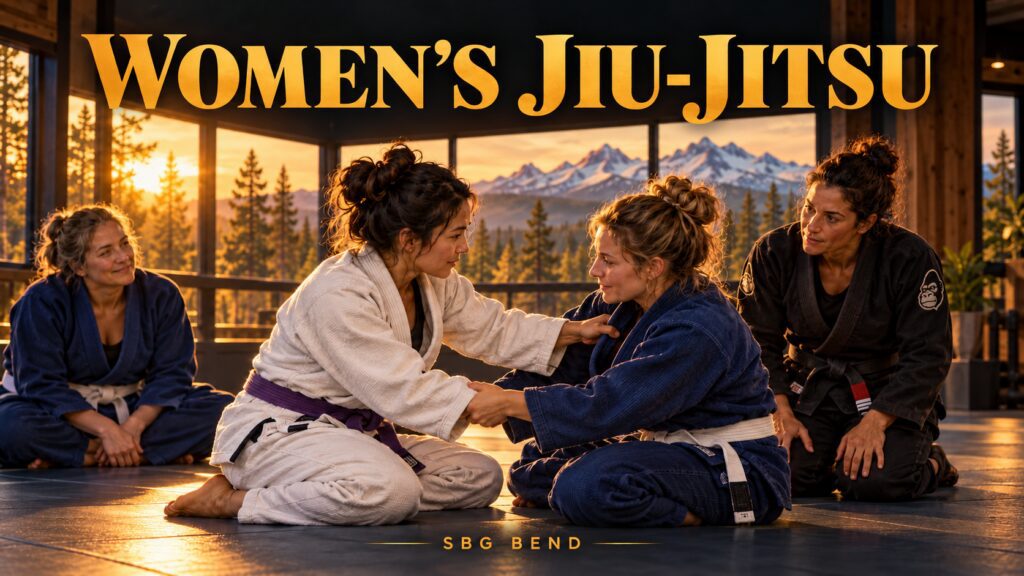
You want to train with other women and learn jiu-jitsu fully. That means having room to work on your escapes, take the top position, try an attack, and ask questions when something isn’t working. You want to become more capable and understand what makes the difference.
At SBG Bend, our women’s-only Brazilian Jiu-Jitsu program welcomes beginners and experienced students, with female coaches and supervised live drills. The invitation is to become an active participant in your own learning: ask a question, work through a problem with a partner, and discover what you can do.
Choose a place where you can explore the whole game
Women’s-only training can be a meaningful part of your jiu-jitsu for as long as you want it to be. You might enjoy the company, value learning from women, or find that this setting helps you participate more fully. Your reasons are yours. They do not have to match anyone else’s.
There is a technical case for that choice, too. In her 2017 essay on women’s-only BJJ, coach Leah Taylor, now Leah Stumpf, described women in her classes trying more attacks, spending more time on top, and exchanging positions more often when training with other women. She also described the class as a place to troubleshoot details. She was describing what she had seen while coaching in Portland and Montana.
The useful question for your own training is whether you get opportunities to explore. Can you practice controlling a position as well as escaping one? Can you try something unfamiliar? Does the coach help you understand a problem when you get stuck?
Women differ in size, experience, athletic background, and temperament. A women’s class still needs thoughtful partner selection and individual coaching. The goal is to give each person a worthwhile challenge and room to learn.
Learn what works when your partner responds
A demonstration can help you understand a movement. Applying it becomes a different problem when your partner changes position or tries to stop you. That is where timing and judgment begin to matter.
SBG calls its approach Aliveness: practice involving timing, energy, and motion. Resistance supplies feedback, and it can be increased gradually. It does not require every exchange to happen at maximum effort. SBG’s I-Method introduces a movement, explores it through a limited live task, then connects it to a broader exchange.
Consider a positional exercise a coach might use: one partner works to maintain side control, a position across the other person’s torso, while the other works toward an escape. With clear limits on the exercise, the coach can adjust resistance so both students have something useful to practice.
If an attempt fails, you have a question to investigate. Where did you lose room to move? What changed when your partner adjusted? You can ask the coach, try a correction, and see what happens. Over time, those experiences give you a firmer basis for trusting a skill.
Bring your own questions to the mat
You do not need technical vocabulary to ask a useful question. “I can do this until she moves that way. What am I missing?” gives a coach a clear place to begin. So does asking what you should pay attention to during the next attempt.
That kind of curiosity belongs in serious training. SBG’s coaching approach emphasizes understanding why fundamentals work and helping students develop their own way of applying them. You should be learning how to solve problems with your body, with enough understanding to recognize when something needs to change.
This also gives you a more useful response to a difficult round. You can identify one part of the exchange to work on instead of turning the entire experience into a judgment about whether you are good at jiu-jitsu. Some days the most valuable thing you learn is where to ask for help.
Learn from women who have made room for others
There is a long history of women shaping SBG’s training community. Their paths also make it easier to see that there is no single biography a new student needs to bring through the door.
In her first-person account of starting martial arts, Lily Pagle described beginning judo at 40 and later earning her BJJ black belt. She placed enjoyment at the center of why she continued. Her story offers a useful reminder: being interested in the practice itself is a substantial reason to start. Your starting age does not tell the whole story of what training can mean to you.
Building places for women to learn together has taken deliberate work, too. In her reflection on SBG’s 2016 women’s camp, Salome Thornton described connecting women across the organization and creating opportunities for newer coaches to teach. She credited a shared effort that included Lily Pagle, Leah Taylor, Kisa Davison, and others.
For a new student, that history points to something practical to look for: experienced women who help newer women participate, share what they know, and take each other’s learning seriously. You can contribute to that kind of community from your first class by being attentive to your partner and giving her room to practice, too.
Expect respect in the small details
A worthwhile challenge depends on how people train together. Ask how partners are matched, how the coach introduces resistance, and what to do if an exercise feels too intense or confusing. The answers should be understandable before you are expected to take part.
Learn the gym’s tapping and verbal-stop procedures before training. Any tap or request to stop must be respected immediately. Tell the coach if you need a break or a different level of contact. BJJ involves close contact and carries injury risk; clear communication and supervision matter.
You can take your learning seriously while being clear about your limits. You also do not owe the room a personal story to explain a boundary. A coach needs enough information to help you train appropriately, and you can ask to discuss a concern privately.
If self-defense is one of your reasons for starting, say so. Ask how that goal connects to the training. Grappling practice can develop relevant skills, but a class or belt cannot guarantee what will happen in a confrontation.
Give yourself a useful first step
Before your first visit, contact SBG Bend and ask which women’s-only class fits your experience and schedule. Confirm who is teaching, what to wear, and whether any equipment is needed. Ask what a beginner should expect to participate in during the trial.
You can keep your message simple: you are interested in women’s-only BJJ, you are new or returning to training, and you would like help choosing a first class. If you have trained before, mention your experience and what you would like to work on.
Afterward, consider what you actually learned. Could you describe the exercise? Did you have a chance to ask a question? Did the coaching help you understand something that had been confusing? Feeling like a beginner is entirely compatible with finding a place where you want to keep learning.
Try women’s-only BJJ at SBG Bend
SBG Bend offers a free trial class for women interested in the program. Contact us to arrange your women’s-only BJJ trial and confirm the current class options. Tell us what brings you to the mat, whether that is a particular goal or simple curiosity.
You can begin with questions. As you practice, you can build answers of your own.
Sources and further reading
1. SBG Bend — Women’s-Only Classes
2. Leah Taylor (2017) — In Defense of Women’s Only Jiu Jitsu Classes
3. Leah Stumpf — Current coach biography
4. SBG — Philosophy, Aliveness, and the I-Method
5. Matt Thornton — Coaching: The SBGi Way (republished 2019)
6. Lily Pagle — First-person account in SBG’s April 2011 newsletter
7. Salome Thornton — SBG Ladies Camp reflection, October 2016
8. Petrisor et al. (2019) — Injury in Brazilian Jiu-Jitsu Training