Let’s start with a confession we hear all the time at SBG Bend:
“I’m looking for Muay Thai.”
Cool. We love Muay Thai.
But here’s the part nobody says out loud: a lot of people who think they want Muay Thai are actually shopping for something slightly different:
- practical standup that holds up under pressure,
- confidence you can actually use,
- self-defense fundamentals (not choreography),
- and a striking skillset that doesn’t evaporate the moment things get messy.
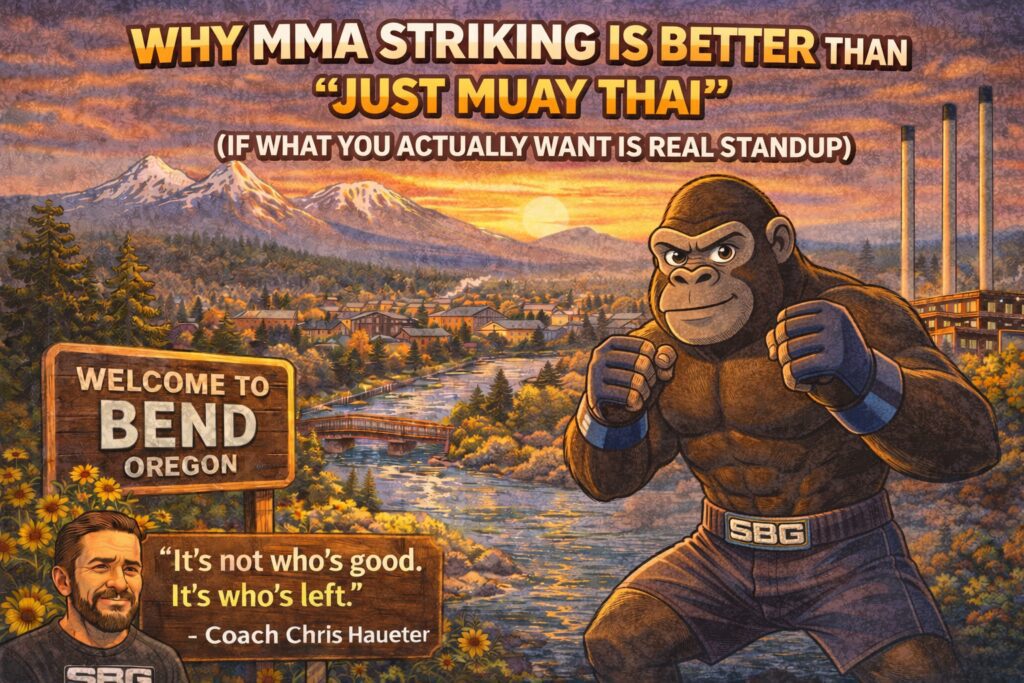
If that’s what you mean, then MMA striking is usually the better choice — not because Muay Thai is “bad,” but because MMA striking includes Muay Thai and adds the context that makes it functional.
In other words: if you want striking that works in the real world, you don’t want “more style.”
You want more truth.
First: when Muay Thai is exactly the right answer
If your goal is to compete in Muay Thai — traditional rules, Thai scoring priorities, ring craft built for that sport — then yes: train Muay Thai with a gym that specializes in that competitive lane.
Muay Thai is one of the most effective striking arts on earth. It produces dangerous athletes, beautiful timing, and brutally efficient weapons.
This isn’t a Muay Thai diss-track.
It’s a simple reality check:
If your goal is functional standup (and self-defense), you don’t want to “overfit” to one sport’s incentives.
Rule-sets create habits. Habits become your default.
Martial arts isn’t magic. It’s habit-training under constraints.
Different sports reward different choices, so fighters develop different defaults:
- how they manage distance,
- what stance they live in,
- which strikes they trust under pressure,
- how they defend when tired,
- and what risks they’re willing to take.
Muay Thai’s environment is a ring with a specific scoring culture.
MMA’s environment is usually a cage, with smaller gloves, and a much bigger threat landscape.
And here’s the big “why”:
In MMA, your striking has to pay the “takedown tax.”
You can still kick. You can still knee. You can still clinch.
But now everything has a price:
- High-commitment kicks get riskier if you can’t recover your base fast.
- Long clinch exchanges change because underhooks, head position, and level changes matter.
- Stance and weight distribution shift because you can’t pretend wrestling doesn’t exist.
Even if you never plan to compete in MMA, that threat awareness makes your striking more transferable — which is exactly what most people mean when they say “practical.”
Why “practical standup” is almost never pure striking
Here’s the part that annoys people until they think about it for 10 seconds:
Most “real” confrontations don’t start at perfect kickboxing range and politely stay there.
Distance collapses. People grab. Balance gets disrupted. The ground becomes an option whether you wanted it or not. The environment is terrible. Your adrenaline does weird stuff to your fine motor skills. Surprise is involved.
So if you train striking in a format where nobody can grab you, change levels, clinch you with intent, or drive you into a wall… you might still get very good at that sport — but you’re not training for the bigger problem.
SBG Bend has written about this “range blindness” problem directly (the idea that if you only train one range, you’re betting your safety on the opponent agreeing to fight there):
Don’t Stop at Striking – Why Range Awareness Matters
.
MMA striking doesn’t magically solve everything — but it forces you to train striking inside the full reality of fighting ranges.
MMA striking doesn’t replace Muay Thai — it includes it (and forces it to grow up)
One of the simplest “why MMA exists” explanations comes from the Singer brothers (SBG lineage). The idea is basically: if you’re already doing boxing, Muay Thai, and jiu-jitsu… why not integrate it and train it as one system?
That’s the point.
MMA striking is integrated striking. It takes the Thai weapons — kicks, knees, elbows, clinch concepts — and blends them with:
- Western boxing footwork, head movement, and punching layers,
- clinch priorities that account for takedowns and body-locks,
- range management that works when someone can crash distance or grab you,
- and defense that functions with smaller gloves and less margin for error.
Or said more bluntly:
MMA striking is Muay Thai with receipts.
The glove problem: why defense has to be different
Big gloves create a bigger “shield.” That’s not an insult — it’s just physics.
Smaller gloves change everything:
- More punches sneak through.
- Long guards behave differently.
- Clinch entries get uglier.
- Defensive responsibility matters more because you can’t just turtle behind padding and hope.
If what you’re after is “functional standup,” you want a program that addresses how real defense works when there’s less margin.
MMA striking tends to do that naturally because it can’t avoid it.
The SBG epistemology (in normal-person English)
“Epistemology” is just a fancy word for: how do we know what’s true?
SBG’s answer is simple: test it.
That’s why SBG talks so much about Aliveness — training with timing, energy/resistance, and motion — because that’s the self-correcting mechanism that keeps martial arts functional.
If you want the deeper context on the SBG philosophy:
Truth, Aliveness, Adaptability
.
And if you want the “why we’re militant about this” version from SBG Bend:
Practical vs. Fantasy – Keeping Martial Arts Real at SBG Bend
.
Matt Thornton has a line that sticks because it’s true: once you really understand aliveness, “you can never be bullshitted again”
(
source
).
That truth-seeking mindset is exactly why MMA striking is such a good fit for practical standup:
it doesn’t ask you to believe. It asks you to prove.
The SBG pedagogy: how we teach striking without turning it into a head-trauma hobby
A lot of gyms try to “add MMA” by doing random hard sparring and calling it realism.
SBG does something more effective (and more sustainable): the I-Method —
Introduction → Isolation → Integration.
We break it down in our beginner content for a reason: the process matters, especially for adults who want to train for years (not weeks):
Brazilian Jiu Jitsu for Beginners at SBG Bend
.
1) Introduction: clean reps, clean understanding
You learn the movement or concept clearly, without resistance — enough detail to do it correctly, not enough to drown in information.
In striking, this is where we build the core mechanics:
- how to stand, move, and keep your balance,
- how to punch without breaking your hands,
- how to kick without falling over,
- and how to see basic lines of attack.
2) Isolation: the skill factory
This is where SBG shines — alive drilling in defined mini-games with progressive resistance. The goal is timing and decision-making, not memorizing combos.
A simple calibration rule we use:
- If you succeed every time, it’s too easy.
- If you fail every time, it’s too hard.
That “sweet spot” is where skill actually forms.
And it matters because it means:
You don’t need gym wars to get functional.
You need intelligent resistance and a structure that keeps you learning.
3) Integration: truth day
Integration is where you plug it into real sparring — not to “win practice,” but to see what survives contact.
This is where the SBG mindset is important. In the SBG coaching tree, you’ll hear the theme over and over: train to learn, not to win Tuesday.
Conor McGregor put it plainly in the SBG environment: “We fight to win but we train to learn.”
And John Kavanagh is known for a line that’s basically the perfect adult-training policy:
“Update the software without damaging the hardware.”
That’s the goal — functional skill, built sustainably.
Complex systems, not complicated systems
A complicated striker collects 10,000 combos.
A functional striker builds first principles:
- base and posture,
- distance management,
- timing,
- defensive responsibility,
- pressure handling,
- clinch survival,
- and an exit strategy.
This matches the “fundamentals aren’t beginner moves” idea we hammer in our own content:
Fundamentals in BJJ: What They Really Mean (and Why They Matter at Every Level)
.
MMA striking tends to build a better self-defense foundation because it forces you to develop transferable fundamentals instead of only performing inside one sport’s incentives.
Why MMA striking often “feels harder” at first (and why that’s a good sign)
One reason people drift toward single-style striking is that it’s easier to feel competent quickly:
- hit pads,
- learn combos,
- get sweaty,
- feel like a monster.
MMA striking adds more variables:
- stance has consequences,
- balance matters more,
- exits matter,
- clinch entries aren’t optional,
- and you can’t pretend one range is “the whole fight.”
So yes — it can feel like “more to think about.”
But that’s the point:
It’s harder because it’s closer to reality.
What you’ll actually get at SBG Bend
If you came here looking for Muay Thai, good news: you’ll learn real Muay Thai fundamentals.
But you’ll learn them inside an MMA striking framework — the version built to transfer when things get messy:
- Muay Thai tools: kicks, knees, elbows, and clinch fundamentals (trained with real posture and balance).
- Boxing layers: jabs, combinations, head movement, angles, and footwork that show up under pressure.
- MMA context: stance and movement that account for level changes, clinch hand-fighting, and separating safely.
- Alive training: timing, motion, resistance — skill that survives contact.
And you get it with the SBG method:
- progressive resistance (not fantasy compliance),
- structured learning (not random sparring wars),
- and a culture that keeps people training long-term.
If you want the “culture” side of that — why ego-free training matters — we spell it out here:
No Ego, No Problem
.
The bottom line
If your goal is Muay Thai as a sport, train Muay Thai.
If your goal is functional standup — self-defense foundations, real pressure, transferable skill — then:
MMA striking is the better choice because it includes Muay Thai and adds the context that makes it work under broader conditions.
Or said SBG Bend-style:
If your training only works when the other person “plays along,” it’s not training.
It’s theater.
Want to try MMA Striking at SBG Bend?
Come experience what “alive” striking feels like — with a structure that keeps you learning, and a culture that keeps training sustainable.
Because you don’t need more combos.
You need skills that survive contact.